

The Essentials at a Glance
- With staking, you put your crypto to work: You deposit it as collateral in a blockchain and earn rewards in return.
- Your stake helps secure the network unlike energy-intensive Bitcoin mining, no computing power is needed.
- You don't need your own tech setup: Through staking pools or providers like BISON, you can get involved with very small amounts.
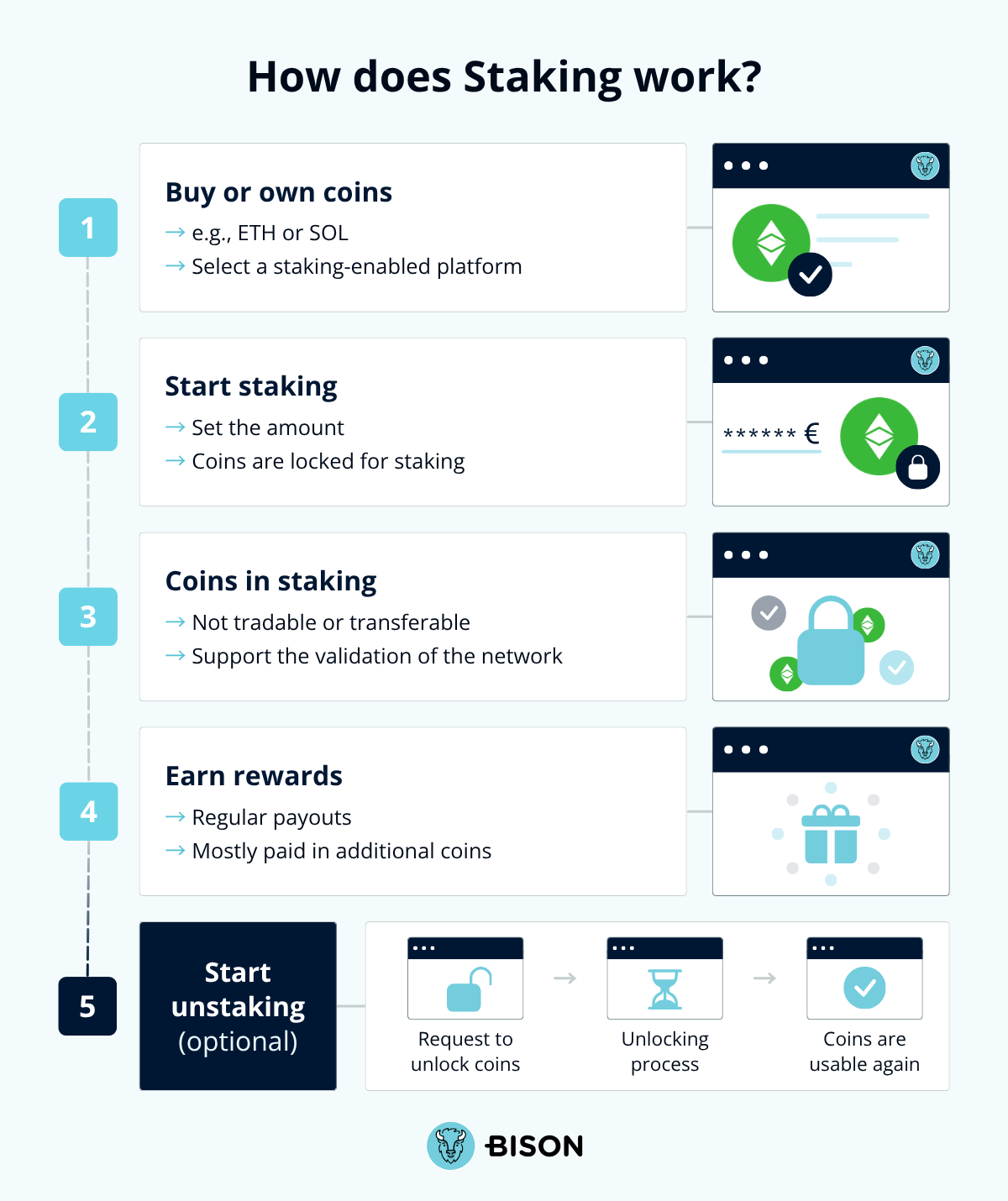
Staking means depositing your own cryptocurrencies in a blockchain network – and earning rewards for it. It’s similar to stocks and dividends: You own something that serves a function – and you’re regularly rewarded for it. The difference: Your coins directly help secure the network.
Why Does a Network Need Security?
Every blockchain faces two questions: How do you decide which transactions are valid and which aren’t? And how do you stop someone from cheating? That’s what a consensus mechanism is for: a set of rules all participants agree on. There are two fundamentally different approaches to this problem.
Proof-of-Work vs. Proof-of-Stake
Proof-of-Work (PoW) is the approach used by Bitcoin. It relies on computing power: Thousands of computers worldwide solve complex mathematical problems around the clock. Whoever finds the solution first gets to add the next block to the blockchain and earns a reward. This process is called mining. It’s secure, but energy-intensive.
Proof-of-Stake (PoS) takes a different approach. Instead of computing power, it requires a financial commitment. Participants put up their own coins as collateral. Follow the rules, and you get your collateral back, plus a reward. Cheat, and you lose your stake. Trust is established without burning through enormous amounts of energy. In short: With PoW, you prove your honesty through work. With PoS, you prove it through skin in the game – you have something to lose.
| Proof-of-Work (PoW) | Proof-of-Stake(PoS) | |
|---|---|---|
| Core idea | Invest computing power to earn the right to validate | Put up coins as collateral to earn the right to validate |
| Protection | Fraud requires unrealistic computing power | Your own stake is on the line |
| Energy use | High | Low |
| Example | Bitcoin | Ethereum, Solana |
Many newer blockchains including Ethereum and Solana use Proof-of-Stake.
What Does a Validator Need?
The participants who verify and confirm transactions in a PoS network are called validators. Being a validator sounds appealing – after all, you earn regular rewards in the form of additional coins. But the bar is high:
- Infrastructure: A validator node needs to run securely and reliably 24/7.
- Minimum deposit: Many blockchains require a minimum stake. For Ethereum, that’s 32 ETH.
- Lock-up period: Your deposited coins are inaccessible for a set period of time.
For most people, that’s too much to take on. That’s where staking pools come in.
What If That’s Too Much for Me?
Not everyone can or wants to run their own validator node. Staking pools offer a simpler path: You delegate your coins to a professional validator who handles the technical side. They run the infrastructure, you receive your share of the rewards – minus a fee for their work. This lets you participate in staking without running your own setup or needing deep technical knowledge.
What Should I Look for When Choosing?
If you want to stake, you’ll need to pick a blockchain – and they don’t all offer the same deal. These questions can help you decide:
- Returns: How high have rewards been historically?
- Lock-up period: How long are my coins tied up?
- Technical barrier: Can I stake through an app, or do I need specialist knowledge?
- Outlook: How is the underlying blockchain developing?
A high return alone doesn’t tell you much – what matters is the full picture: yield, restrictions, and risks.
Staking with BISON
With BISON, you can stake simply, securely, and reliably – starting with very small amounts. Put your crypto to work and earn passive income through weekly rewards. Two cryptocurrencies are currently available for staking:
| Cryptocurrency | Minimum amount | APR (annual percentage rate) |
|---|---|---|
| Ethereum (ETH) | from 0.005 ETH | 2 to 5%* |
| Solana (SOL) | from 0.1 SOL | 4 to 8%* |
* applicable fees can be found on our fees page at any time
As part of Boerse Stuttgart Group, BISON is committed to the highest security standards: Your staked coins never leave our fiduciary and regulated custody in Germany. With ETH staking, there’s what’s known as a slashing risk: If a validator violates network rules, deposited coins can be lost. To protect you from this, we’ve developed a dedicated insurance solution together with Munich Re.
Learn more about BISON’s staking offeringMehr zum Staking-Angebot von BISON
Please note that this service is currently not regulated under MiCAR and lacks the protections and oversight established by EU regulations. For comprehensive information on staking risks, please refer to the Special Terms and Conditions for Staking.