

Summary
- Smart contracts are digital agreements written as computer code and stored on a blockchain. They automatically execute predefined actions based on simple if-then logic.
- They form the foundation of many blockchain applications, including DeFi (Decentralized Finance), NFTs, blockchain gaming, insurance solutions, and digital identities.
- The leading smart contract blockchains include Ethereum, Solana, Cardano, Avalanche, and TRON. Bitcoin only supports smart contracts to a limited extent.
- Compared to traditional paper contracts, smart contracts offer automation and transparency, reduced reliance on intermediaries, and 24/7 global availability.
Definition: What Is a Smart Contract?
A smart contract is an immutable digital agreement written as computer code and stored on a blockchain. It automatically executes predefined conditions as soon as they are met, enabling transactions, agreements, and even entire business processes to be carried out in a decentralized manner.
Smart contracts do far more than transfer cryptocurrencies—they serve as the foundation and backbone of decentralized finance (DeFi) . Their growing importance has also been recognized by the financial industry. A PwC study conducted in 2023 found that 52% of financial services professionals planned to implement smart contracts in the short to medium term.
How Do Smart Contracts Work on a Blockchain?
Smart contracts follow a simple if-then logic: once a predefined condition is met, a specific action is executed automatically. The underlying code is stored on a decentralized blockchain, where it is validated and executed by network participants.
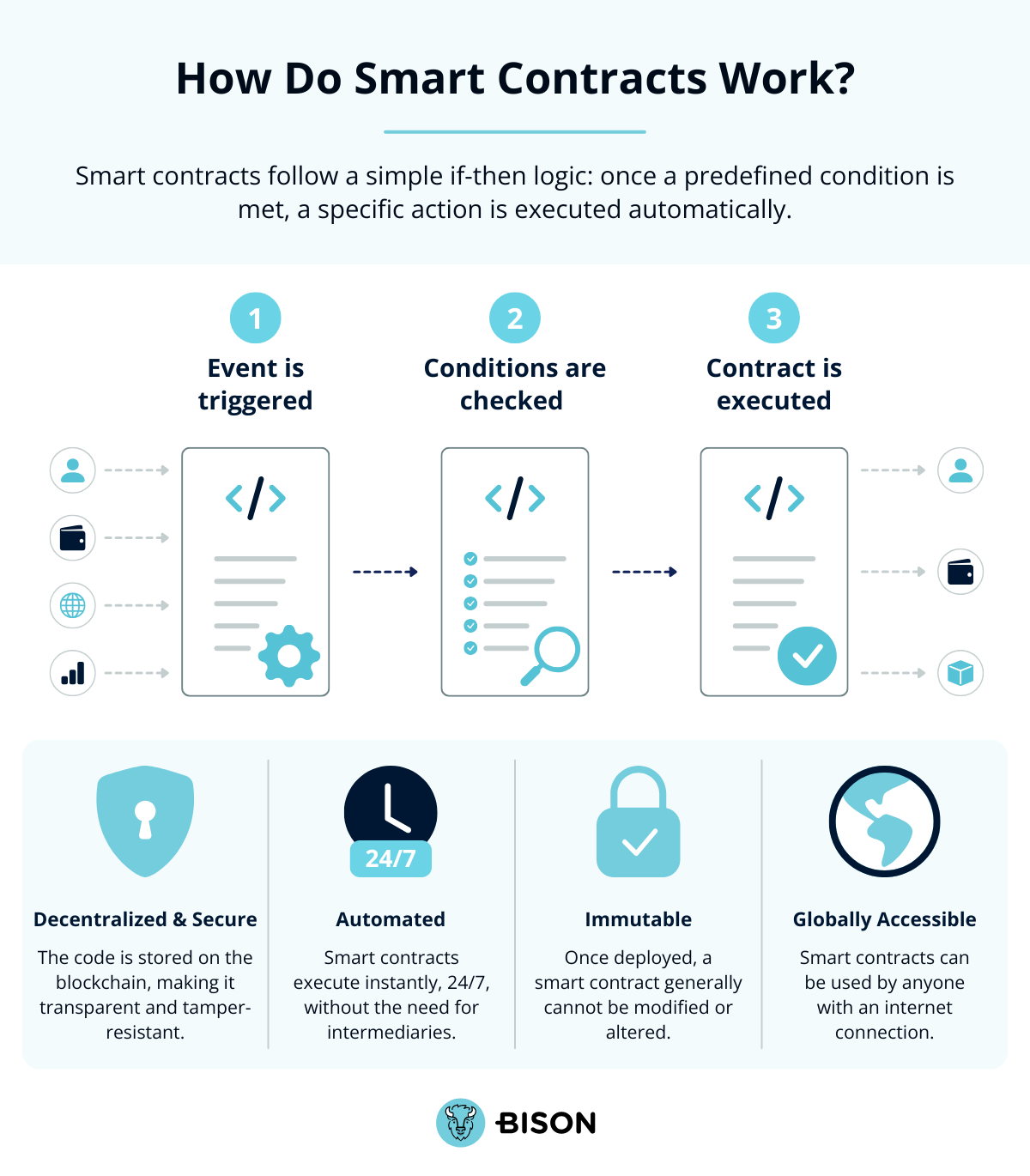
A simple example of how a smart contract works:
- You want to buy an NFT artwork and send 5 Solana (SOL) to a smart contract as payment.
- The smart contract checks whether the NFT is still available and whether all predefined conditions have been met.
- If the requirements are satisfied, the smart contract automatically transfers the 5 SOL to the seller, and ownership of the NFT is transferred to you. The contract is executed without any manual intervention.
- The transaction is permanently recorded on the blockchain.
If a smart contract requires information from outside the blockchain—for example, whether an event has occurred that triggers an insurance payout—it relies on oracles. Oracles act as bridges between the blockchain and the real world by supplying external data such as market prices, weather conditions, or sports results. The best-known oracle network is Chainlink (LINK).
Smart Contracts vs. Traditional Contracts: What Are the Differences?
With a traditional contract, you typically rely on a bank, notary, or another intermediary to ensure that the agreement is executed correctly and legally. In the case of smart contracts, this role is fulfilled by the smart contract’s code running on the blockchain, eliminating the need for additional intermediaries.
As a result, smart contracts offer a high level of security and transparency and, at least in theory, cannot be altered or tampered with once deployed.
Bitcoin, Ethereum, Solana: Which Blockchains Support Smart Contracts?
Some of the best-known blockchains with smart contract functionality include Ethereum, Solana, Cardano, Avalanche, and TRON. All of their native cryptocurrencies are also available to trade on BISON. In contrast, the Bitcoin blockchain supports smart contracts only to a limited extent.
A new concept called Cube, proposed by developer Burak, aims to enable complex smart contracts directly on Bitcoin without modifying the base protocol or relying on potentially insecure bridges. Whether Cube will succeed remains to be seen. As of June 2026, the project is still at a theoretical stage.
What Are the Main Use Cases for Smart Contracts?
Smart contracts are useful wherever digital processes need to be executed automatically, transparently, and without intermediaries. Their most important application is decentralized finance (DeFi), but they are also widely used in NFTs, blockchain gaming, insurance, and supply chain management.
| Use Case | Explanation & Examples |
|---|---|
| DeFi | Identity credentials and personal data can be securely managed and verified in a decentralized way. |
| NFTs | Digital ownership rights are automatically created, transferred, and permanently recorded on the blockchain. |
| Blockchain Gaming | Smart contracts enable trading of in-game assets, distribution of rewards, and management of other digital items. |
| Insurance | Insurance payouts can be triggered automatically once a predefined event occurs. |
| Supply Chain Management | Product movements, proof of origin, and payment approvals can be tracked and documented transparently. |
| Digital Identities | Identity credentials and personal data can be securely managed and verified in a decentralized way. |
What Are the Advantages and Disadvantages of Smart Contracts?
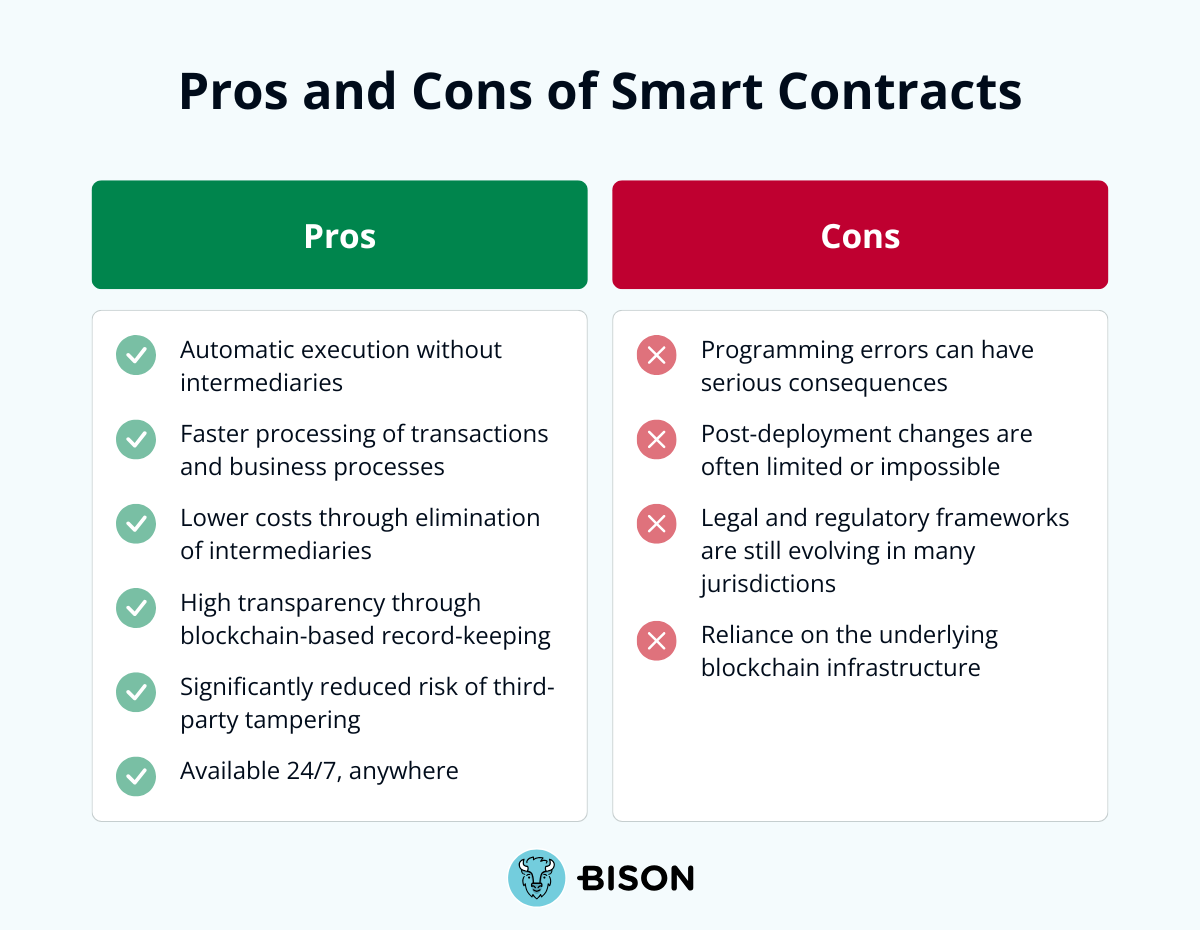
Smart contracts offer several advantages over traditional contracts. They execute automatically, eliminate the need for intermediaries, and provide a high level of transparency through blockchain technology. They’re available around the clock worldwide, making them highly efficient for digital transactions.
At the same time, smart contracts come with certain risks. Programming errors or vulnerabilities in the code can have serious consequences, and once deployed, contracts are often difficult or impossible to modify. In addition, the legal framework for smart contracts is still evolving in many countries, and their functionality depends on the capabilities and security of the underlying blockchain.
FAQ
What Are Smart Contracts Used For?
Smart contracts are primarily used in decentralized finance (DeFi). Common applications include cryptocurrency transfers on decentralized exchanges (DEXs), NFT purchases, staking, crypto lending, and automated insurance payouts on blockchain-based platforms. They are also increasingly used in areas such as supply chain management, digital identities, and blockchain gaming.
Who Invented Smart Contracts?
The concept of smart contracts was first proposed in 1994 by computer scientist Nick Szabo. However, the concept only became practical with the emergence of blockchain technology. The launch of the Bitcoin blockchain in 2009 laid the foundation, while the introduction of Ethereum in 2015 made programmable smart contracts widely accessible.
How Can I Create a Smart Contract?
A smart contract is written in a programming language such as Solidity or Vyper, then thoroughly tested before being deployed on a compatible blockchain such as Ethereum. One of the biggest challenges is identifying and fixing bugs. According to researchers in Singapore, 88.8% of surveyed developers described debugging smart contracts as “extremely difficult and time-consuming.” This highlights the importance of rigorous testing and security audits before deployment.
What Does It Cost to Use a Smart Contract?
Executing a smart contract usually requires paying gas fees, which are transaction fees charged for using the blockchain network. The cost depends on the blockchain, current network congestion, and the complexity of the smart contract. Fees can range from just a few cents to several tens of euros per transaction.
Can a Smart Contract Be Manipulated?
Once deployed, a smart contract generally cannot be altered or tampered with, because its code is permanently recorded on the blockchain. However, vulnerabilities in the contract’s code or the underlying protocol can still be exploited. For example, in 2025, the Cetus Protocol suffered an attack in which approximately $200 million was stolen. The exploit was linked to weaknesses in the protocol’s smart contract mechanisms, illustrating the importance of secure coding, testing, and regular audits.