

Summary
- With leverage, you can trade a multiple of your invested capital on the market. This can amplify both gains and losses.
- In a long position, you are speculating on rising prices by buying an asset with the aim of selling it later at a higher price.
- A short position, by contrast, is based on falling prices and allows you to generate profits even in declining markets.
- Leverage, long, and short positions are often combined in derivatives trading for example, with perpetual futures.
- Risk management is essential, as market volatility can quickly lead to significant losses in leveraged positions.
What is leverage in trading?
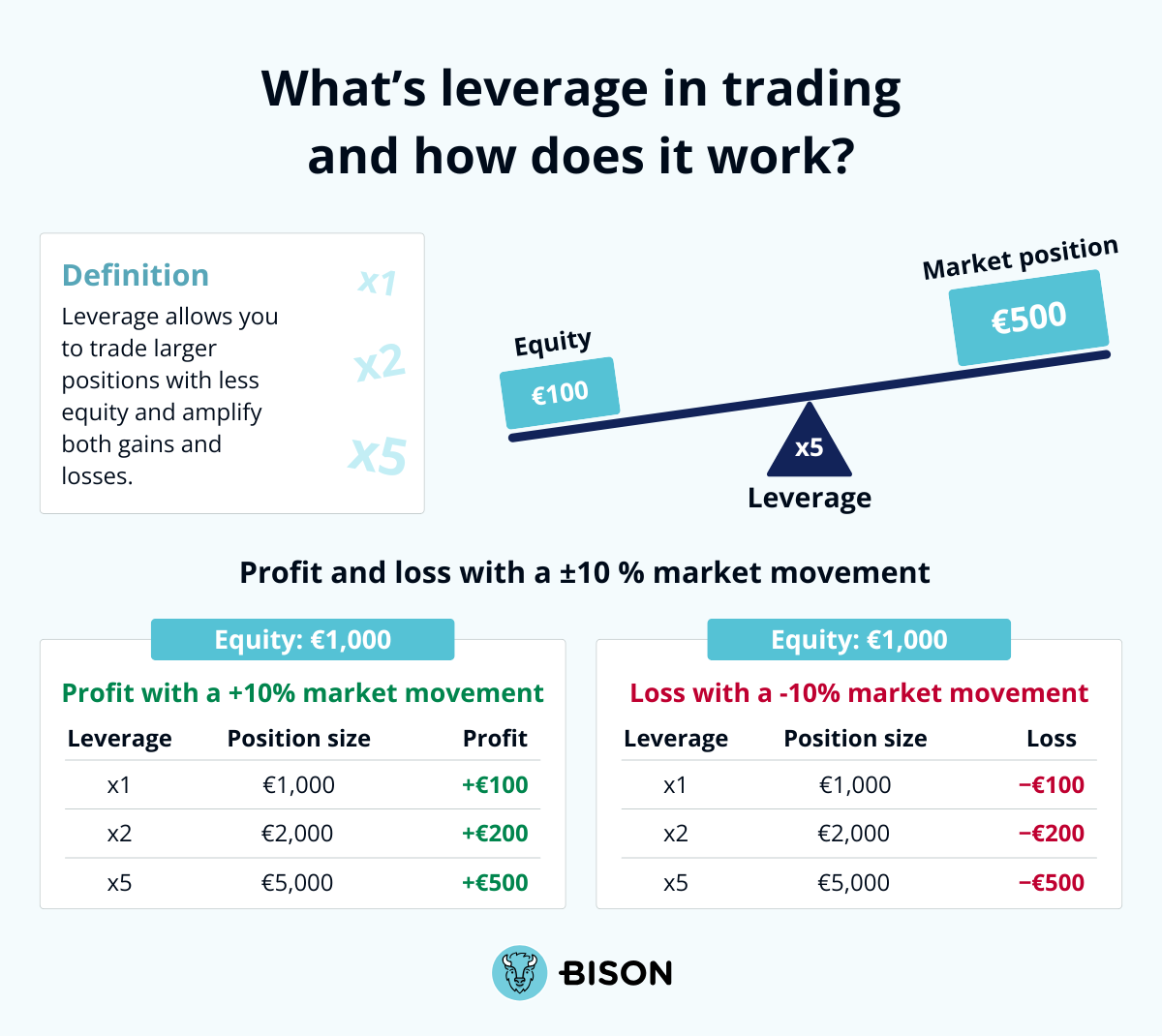
Leverage is a technique that allows you to increase the potential returns of an investment by using borrowed capital. With leverage, you can gain greater market exposure than would be possible with your own capital alone. It is important to understand that while leverage can increase gains, it can also increase potential losses.
| Invested capital | Leverage | Position size | Market movement | Impact on your capital |
|---|---|---|---|---|
| €1,000 | x1 | €1,000 | +10% | +€100 (+10%) |
| €1,000 | x2 | €2,000 | +10% | +€200 (+20%) |
| €1,000 | x5 | €5,000 | +10% | +€500 (+50%) |
| €1,000 | x1 | €1,000 | −10% | −€100 (−10%) |
| €1,000 | x2 | €2,000 | −10% | −€200 (−20%) |
| €1,000 | x5 | €5,000 | −10% | −€500 (−50%) |
How does leverage work?
Leverage is typically expressed as a ratio, such as 2:1, 3:1, 4:1, or higher. This ratio reflects the amount of borrowed funds—for example, x2, x3, or x4—in relation to your own investment.
Example of leverage
Suppose you use leverage of 2:1 for a crypto investment of €1,000. This means you control a market position worth €2,000. If the price of the underlying asset in this case, the cryptocurrency rises by 10%, your profit is €200, which is 10% of €2,000. This effectively doubles the profit you would have made using only your own capital, minus the costs of borrowing the additional €1,000 and the costs of trading.
Potential losses when using leverage
While leverage can magnify gains, it also increases the potential for losses. If the market moves 10% against your position, you lose €200, which corresponds to a loss of 20% of your original investment of €1,000. In other words, leverage amplifies not only gains, but also losses.
Costs of leveraged positions
Trading leveraged products is more complex than trading without leverage. You should be aware of the following costs:
- Trading fees and spread: Fees for opening and closing a position, as well as the difference between the buy and sell price, known as the spread. These costs usually also apply to unleveraged positions, unless the provider offers commission-free trading. With BISON, for example, you do not pay any trading fees and only pay the standard market spread.
- Financing fees, or funding rate: With perpetual futures, for example, payments are regularly settled between long and short positions.
- Liquidation costs: If a position is liquidated, additional fees may apply.
The term margin is also frequently used in connection with leverage. It refers to a type of security deposit that you must provide when opening a leveraged position. If your margin is no longer sufficient due to losses, your position may be liquidated automatically.
What is a long position?
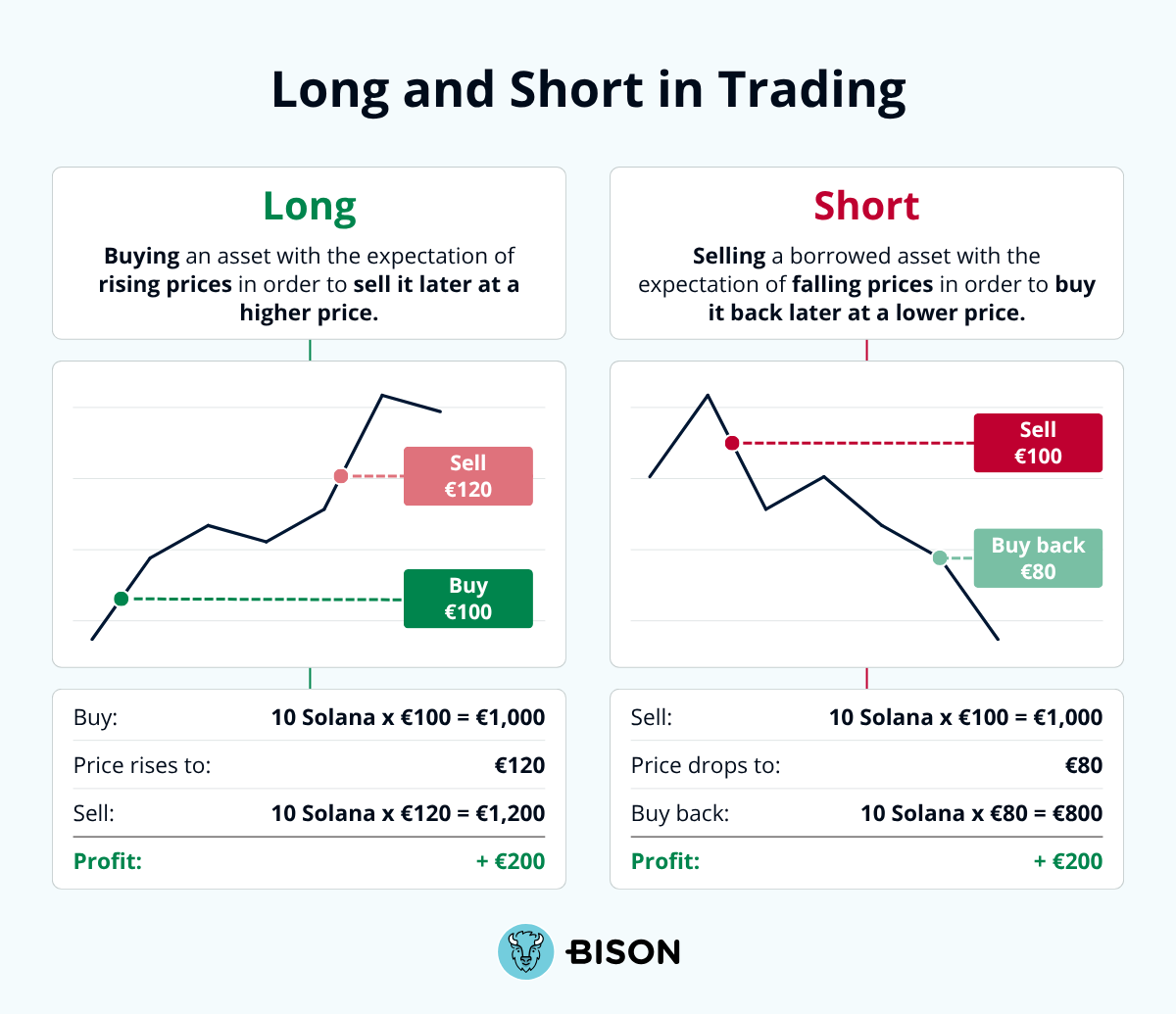
In a long position, you buy an asset, such as Bitcoin, with the expectation that its value will rise over time. If the price does rise, you can close the position later at a higher price and make a profit.
Example of a long position
For example, if you buy ten Solana via BISON at €100 each, for a total of €1,000, and the coin rises to €120, your investment would then be worth €1,200. If you sell your Solana position at that price, you would close your long position and make a profit of €200 before fees.
What is a short position?
In a short position, you are speculating that the value of an underlying asset, such as a cryptocurrency, will fall. If the price does fall, you can close the position later at a lower price and make a profit. These types of trading strategies are often implemented using derivatives, such as perpetual futures, which you can also trade with BISON.
Example of a short position
Suppose you open a short position on Solana when the price is €100. If the price subsequently falls to €80, you can close your position at this lower price. The difference of €20 per coin corresponds to your profit from the short position before any applicable fees.
How are leverage, long, and short related?
Leverage, long positions, and short positions are often combined in trading. A long position is based on rising prices, while a short position is based on falling prices. Leverage determines how strongly price movements affect your profit or loss.
| Position | Market development | Result |
|---|---|---|
| Long | Price rises | Profit |
| Long | Price falls | Loss |
| Short | Price falls | Profit |
| Short | Price rises | Loss |
Using leverage in combination with long or short positions therefore gives you greater flexibility when trading assets such as cryptocurrencies, or financial products based on Bitcoin and the like. It allows you to multiply your invested capital in any market phase and potentially increase your profits many times over. At the same time, leveraged positions also increase the risk of higher losses, which makes a good risk management strategy essential.
One example of this was the cryptocurrency market downturn in October 2025. Prices of many cryptocurrencies fell sharply within a short period of time. Traders with leveraged long positions were at risk of significant losses, with around USD 19 billion in leveraged crypto positions liquidated. Short positions, on the other hand, would have benefited from the falling prices.