

Kurzzusammenfassung
- Meme coins are cryptocurrencies that arise from internet trends. Their prices are largely driven by the communities behind them and attention on social media.
- In contrast to traditional cryptocurrencies, many meme coins lack a clear use case. It is therefore difficult to determine their fundamental value their prices are mainly based on hype, sentiment, and speculative demand.
- Well-known examples such as Dogecoin or Shiba Inu show that individual projects can achieve significant market capitalizations and develop real-world use cases despite their meme origins.
- The prices of meme coins are highly volatile with strong swings in both directions within a few hours are not uncommon.
- Investing in meme coins involves higher risks than established cryptocurrencies, but it can provide high profits in the short term.
- From a regulatory perspective, meme coins are subject to the same framework conditions as other cryptocurrencies. However, authorities such as BaFin classify them as highly speculative.
Explanation and meaning: What is a meme coin?
A meme coin is a cryptocurrency that originates from the meme culture of the internet. Memes are viral images, videos, or jokes that are shared millions of times. Compared to traditional crypto projects, meme coins are often created from an idea that is deliberately humorous, provocative, or community-driven. Utility takes a back seat.
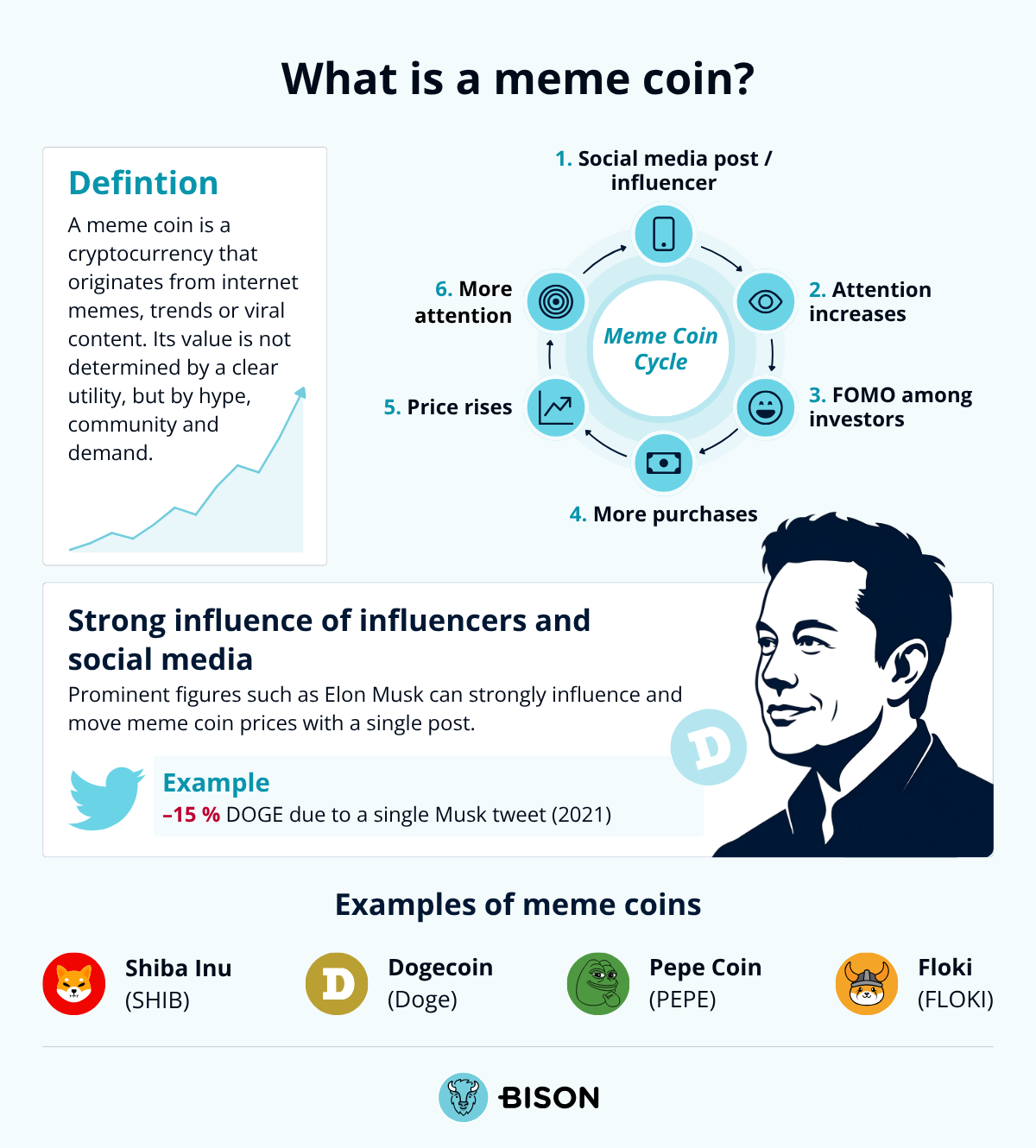
In many cases, their value is therefore not determined by a clear use case, but exclusively by supply and demand—strongly influenced by hype, sentiment, and visibility.
Some of the best-known and largest meme coins include Dogecoin (DOGE), Shiba Inu (SHIB), Pepe (PEPE), Bonk (BONK), FLOKI (FLOKI), dogwifhat (WIF), and Popcat (POPCAT), all of which you can also trade on BISON.
What is the difference between meme coins, Bitcoin, and altcoins?
The clear difference between meme coins like Shiba Inu and traditional cryptocurrencies like Bitcoin and Ethereum lies in the underlying value proposition. Classic coins usually solve concrete problems or offer technological innovation. Meme coins, on the other hand, are entertaining, hype-driven, and depend almost entirely on media attention.
| Criterion | Meme Coins | Traditional cryptocurrencies |
|---|---|---|
| Origin | Internet memes, trends | Technological innovation |
| Objective | Attention, community, value enhancement | Concrete benefits (e.g. for payments, smart contracts), increase in value |
| Value drivers | Hype, social media, demand, influencers, trends, market sentiment | Use, technology, adoption, partnerships |
| Volatility | Very high | High, but often more stable |
| Examples | Dogecoin, Shiba Inu, Pepe, OFFICIAL TRUMP, Bonk | Bitcoin, Ethereum, XRP, Cardano, Solana |
From meme coin to serious cryptocurrency Some meme coins have actually made this leap away from pure “fun coins” to projects with real use cases. The best example is Dogecoin. The currency is increasingly moving beyond its meme character. For example, you can use DOGE to buy Tesla merchandise.
What are the characteristics of meme coins?
Despite their diversity, most meme coins are very similar. In addition to a strong community, their most important characteristics include high volatility and a lack of use cases:
- Strong community: Success depends largely on an active and engaged community.
- Influence of social media: Platforms such as X, Reddit, or TikTok play a central role in visibility and price development.
- High volatility: Prices can rise sharply within a short period of time—but they can also fall again quickly.
- Little or no use case: Many meme coins have no clear practical use or only develop one later.
- Low barriers to entry: New tokens are relatively easy to create technically, which explains the high number.
- Strong influence of market psychology: Factors such as FOMO (fear of missing out) or herd instinct often influence demand more strongly than fundamental data.
Dog-related meme coins are particularly in demand. The report “State of Memecoins 2025” by CoinGecko provides a curious statistic: In addition to the well-known meme coins Shiba Inu and Dogecoin, many others refer to dogs in some form. These dog meme coins account for around 90% of the market capitalization of all meme coins.
How do meme coins work?
Technically, meme coins work like many other cryptocurrencies. They are based on existing blockchains such as Ethereum or Solana and are created there as tokens. Transactions are processed in a decentralized manner, with trading taking place via platforms such as Binance and apps such as BISON. Strong influence of influencers and social media Meme coins are closely linked to social media—and thus also to influencers and famous personalities who express their opinions on X, Reddit, Threads & co. Probably the most prominent example is Elon Musk, whose tweets have repeatedly triggered strong price movements in Dogecoin in the past. In 2021, for example, a critical tweet caused DOGE to fall by 15%.
Meme coins are closely linked to social media—and thus also to influencers and famous personalities who express their opinions on X, Reddit, Threads & co. Probably the most prominent example is Elon Musk, whose tweets have repeatedly triggered strong price movements in Dogecoin in the past. In 2021, for example, a critical tweet caused DOGE to fall by 15%.
How can I trade meme coins?
Like other cryptocurrencies, you can buy, store, and sell meme coins via trading platforms or specialized apps. Trading is usually done against fiat currencies (in the case of BISON against EUR) or other cryptocurrencies.
The typical procedure is as follows:
- Create an account with a crypto platform
- Deposit money (often by bank transfer, alternatively deposit coins)
- Choose and buy meme coin
- Store them in the platform’s wallet or an external wallet
Important: Not every app and every platform offers every meme coin. At BISON, you can trade a whole range of meme coins easily, safely, and reliably—including DOGE, SHIB, PEPE, BONK, FLOKI, WIF and POPCAT.
Is it worth investing in meme coins?
Whether an investment is worthwhile depends heavily on the meme coin itself and your risk tolerance. Although the high volatility of meme coins can result in high profits in the short term, they are also riskier than cryptocurrencies that fluctuate less.
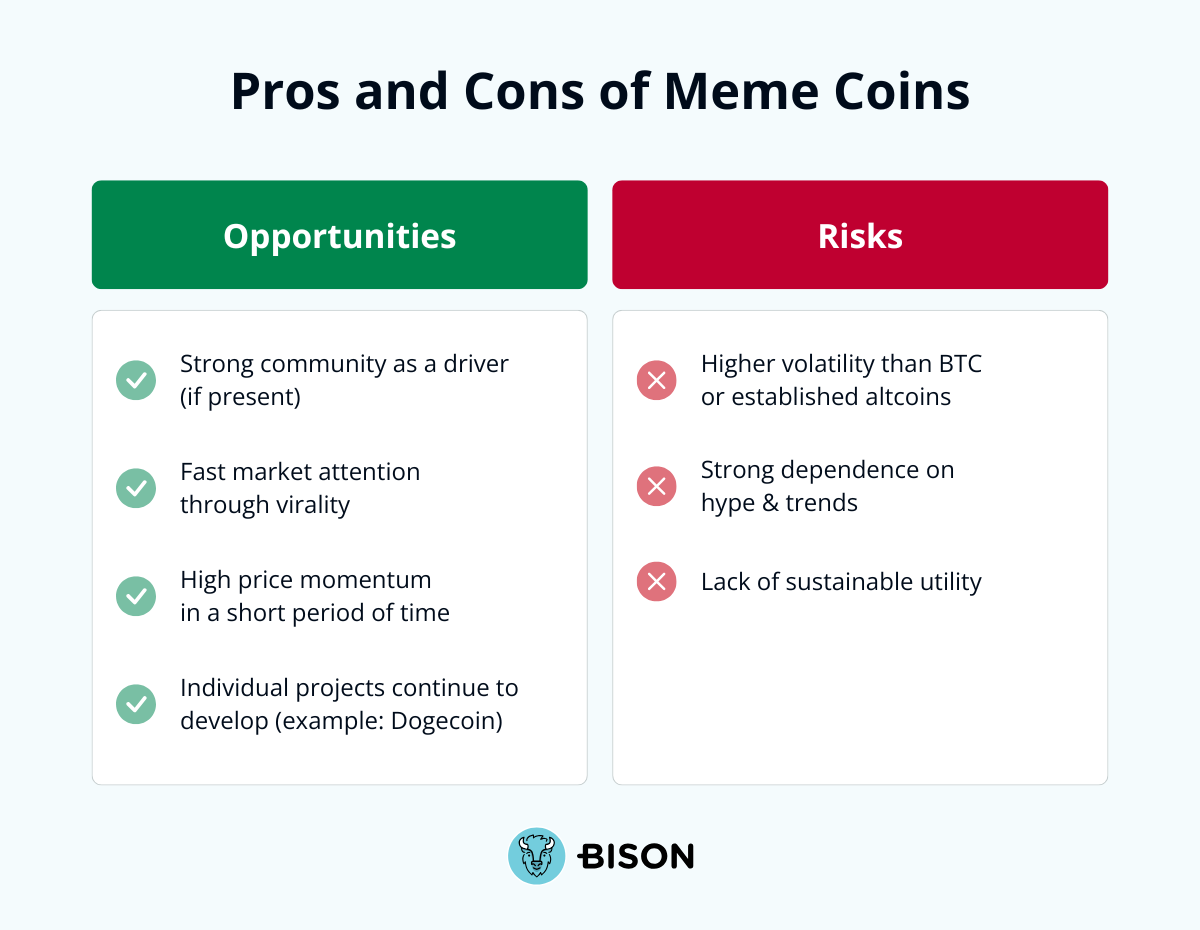
BaFin calls such cryptocurrencies “highly speculative virtual coins”, whereby the distinction between well-known projects such as PEPE or SHIB and shady coins is important.
How are meme coins regulated?
Meme coins are basically subject to the same regulatory framework as other cryptocurrencies. In the EU, MiCAR creates uniform rules for crypto providers and increases transparency and investor protection. This makes it more difficult for dubious providers to offer their tokens via regulated platforms—even though meme coins themselves are often still regulated to a limited extent.
FAQ
What meme coins are there?
Some of the most well-known meme coins—and those with the highest market capitalization—include Dogecoin, Shiba Inu, Pepe, and Bonk. However, new meme coins are created every day—at the same time, many disappear from the market or are of little interest to the wider market.
How many meme coins are there?
The exact number of meme coins is very difficult to determine, as new tokens are constantly being created and old ones are being taken off the market. Estimates were for 40,000 to 50,000 new meme coins per day in 2024. CoinMarketCap lists over 5,100 tradable coins—the actual number is likely to be higher, as many projects are never listed.
Are meme coins risky?
Studies show that meme coins often have similar patterns to traditional speculative bubbles. According to a study by Daniel Gallego and Joenn Asher, price movements are driven primarily by sentiment, community dynamics, and speculative behavior—not by intrinsic value. While this can allow for high profits, it also brings with it higher volatility and an increased risk of sudden price drops.
Which is the biggest meme coin?
Dogecoin is the largest meme coin on the market with a market capitalization of around 14 billion euros (as of 15.04.2026). It contributes just under 50% of the market capitalization of the entire meme coin market.
Is Bitcoin a meme coin?
No, Bitcoin is the first, largest, and best-known cryptocurrency with clear utility and therefore not a meme coin.
Do meme coins have potential?
Meme coins can gain a lot of value in the short term, with the PEPE price, for example, rising by around 700% within a few days in April 2023. In the long term, however, their potential is difficult to assess unless they develop real use cases, such as DOGE. Examples of failed meme coins include BEERCOIN and BALD.
Can I create my own meme coin?
Yes, theoretically and technically, it is relatively easy to create your own meme coin today—often you “only” need to create and publish a token on existing blockchains such as Ethereum or Solana. The real challenge lies in generating the media attention needed to drive price increases.