

At a Glance
- Perpetual futures are crypto derivatives that allow traders to speculate on rising or falling cryptocurrency prices without having to buy the underlying coins themselves.
- A perpetual futures contract, often simply called a “perpetual” or “perp,” is a financial instrument with no fixed term or expiration date. As the name suggests, “perpetual” means lasting indefinitely.
- When you trade perpetual futures, leverage amplifies the impact of price movements on your invested capital (margin). This means that both profits and losses can be significantly larger.
- Among other mechanisms, the funding rate (a payment exchanged between traders) helps keep the price of a perpetual future close to the current market price.
- Important: Perpetual futures are complex and high-risk financial products and are therefore suitable only for experienced users. In the BISON app, you’ll find them under the name “crypto derivatives.” BISON is the first provider regulated in Germany to offer these products.
What Is a Perpetual Futures Contract?
A perpetual futures contract is a crypto derivative with no expiration date that tracks the price of a cryptocurrency. Ongoing price movements in the underlying asset can result in profits or losses for traders of perpetual futures.
With this type of product, you speculate on whether the spot price of a cryptocurrency will rise or fall. To do this, you open a long or short position, depending on whether you expect the price of the underlying cryptocurrency—such as Bitcoin or Ethereum—to increase or decrease. Some trading platforms, such as BISON, allow you to increase your position size using leverage without having to commit more of your own capital. This means that even small price movements can lead to substantial profits—but also substantial losses.
Derivatives are financial products whose value is linked to an underlying asset. This could, for example, be the price of a stock or a commodity. Perpetual futures are a type of crypto derivative, meaning that their underlying assets are cryptocurrencies.
Key Features of Perpetual Futures: What Should You Consider Before Trading?
Perpetual futures are complex financial instruments that involve significant financial risks. Before trading, you should take a close look at the key features and characteristics of perpetual futures contracts, as these have a major impact on how the product is priced and on its overall risk profile.
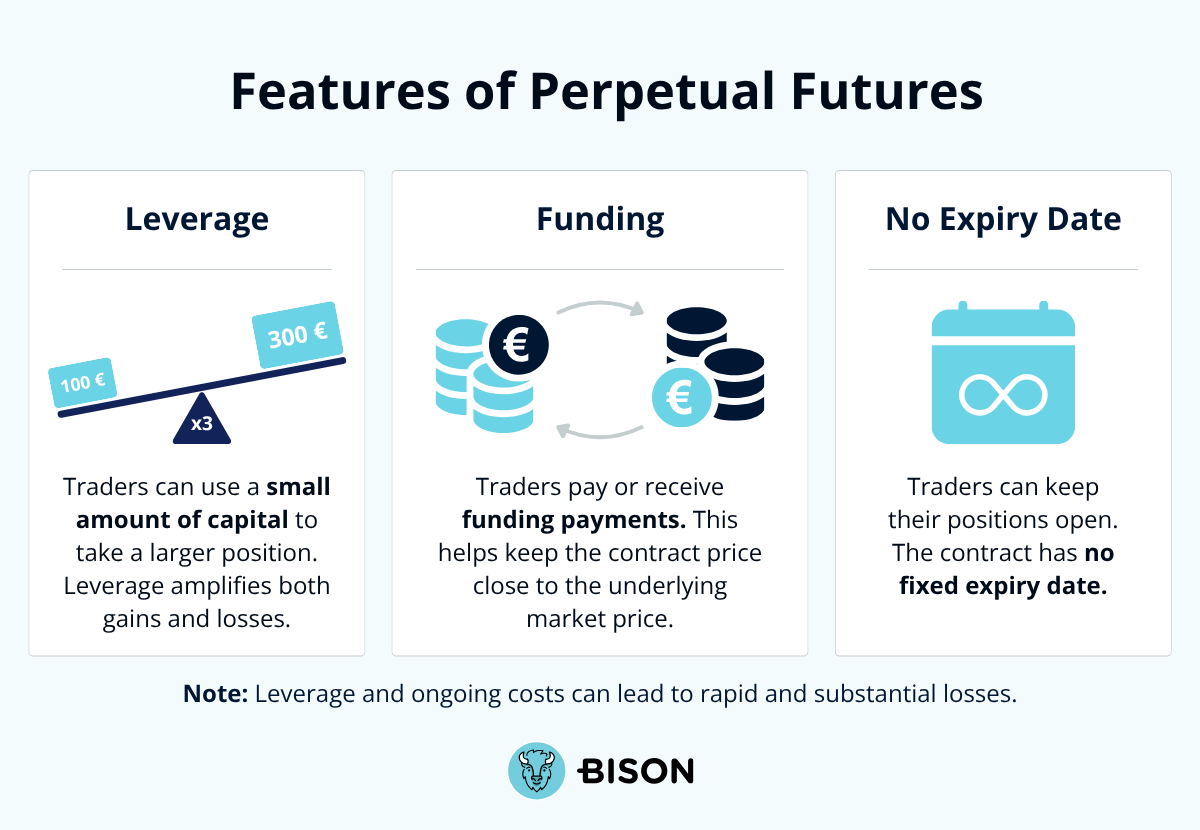
Key factors include the ability to trade with leverage, the funding mechanism (funding rate), the risk of liquidation, and the fact that perpetual futures have no expiration date.
Margin and Capital Used for Perpetual Futures
When trading perpetual futures, you deposit a certain amount of money as collateral (margin). This amount serves as the collateral required to open a position. Losses are deducted directly from your margin. If your margin is no longer sufficient to maintain the position, the position is automatically liquidated. In this case, you can lose the entire amount you have committed very quickly.
When trading perpetual futures contracts, you will typically come across two types of margin:
- Initial Margin: The minimum amount required to open a leveraged position.
- Maintenance Margin: The minimum amount required to keep a position open. If your margin falls below the required level, your position may be liquidated.
Long and Short Positions in Perpetual Futures
When trading perpetual futures, you have two options: go “long” or go “short.” If you expect the price of a cryptocurrency to rise, you open a long position:
- If the price of the underlying asset rises, you make a profit.
- If the price falls, you incur a loss.
With a short position, the opposite applies. Here, you are speculating on a decline in the price of the underlying asset—meaning you can potentially make a profit even when the crypto market is falling:
- If the price of the underlying asset falls, you make a profit.
- If the price rises, you incur a loss.
Leverage When Trading Perpetual Futures
Leverage allows you to trade a perpetual futures contract with a position size that is a multiple of the capital you have committed. The leverage factor determines how much larger your position can be compared with the amount of capital you have committed.
For example, with BISON’s crypto derivatives, you can choose between three leverage levels: 1x, 2x, and 3x. Other platforms may offer higher levels of leverage. When opening a position, you determine how large your position can be relative to the margin you have committed. Leverage works both ways: it can amplify profits, but it can also amplify losses.
The level of risk depends not only on the direction of the price movement, but also on the leverage you choose, the size of your position, and how quickly the price moves. Leverage can generate disproportionately large gains with a relatively small amount of capital—but it also increases the risk of significant losses.
Liquidation of Perpetual Futures
A perpetual futures contract is automatically liquidated (closed) when losses become so large that the margin provided by the trader is no longer sufficient to maintain the position. In this case, the trading platform automatically closes the position, and the margin used is lost. Liquidation can occur within a very short period of time and generally results in the complete loss of the capital committed.
How the Funding Rate Works for Perpetual Futures
The funding rate is an ongoing mechanism that determines the payments exchanged between traders when trading perpetual futures. It helps keep the price of a perpetual future close to the underlying asset’s market price by incentivizing traders to take opposing positions. Depending on market conditions and whether you are betting on rising or falling prices, you may either receive funding and benefit from it or have to pay it:
- When the funding rate is positive, longs pay shorts.
- When the funding rate is negative, shorts pay longs.
The funding rate helps balance buying and selling pressure in the market.
The funding rate is an ongoing mechanism that applies as long as a position remains open—even when the price moves sideways. At BISON and on most other platforms, the funding rate is calculated approximately every eight hours. Funding payments can reduce the margin available for a position and therefore increase the risk of automatic liquidation.
Are Perpetual Futures Suitable for Beginners?
Perpetual futures are not suitable for beginners. They are considered complex, highly leveraged products that can react very quickly to price movements. Even small price changes can result in significant losses or liquidation. In addition, trading perpetual futures may involve funding payments, which can reduce your margin even when there are no significant market movements. Trading perpetual futures therefore requires a solid understanding of how they work and the risks involved.
How Do You Trade Perpetual Futures?
You can trade perpetual futures on platforms such as BISON by opening either a long or a short position. Since perpetual futures can be traded around the clock, open positions require constant attention and active risk management. Here’s how trading a perpetual futures contract works:
- Set your position size: First, specify how much capital you want to commit—your margin. The corresponding amount of the underlying asset is calculated automatically.
- Choose your leverage: The higher the leverage, the larger your market position will be relative to your margin. The liquidation price is adjusted automatically.
- Review the details: Trading platforms generally provide an order overview showing all relevant details. Review the information carefully before opening your position.
- Take Profit / Stop Loss (optional): Some platforms offer additional order options. On BISON, for example, you can optionally set a take-profit or stop-loss order to automatically close your position when the price reaches a specified level.
- Open your position: Once everything is set up correctly, open your perpetual futures contract.
- Monitor your position: You should keep an eye on your position for as long as it remains open. Losses can increase quickly, especially when using high leverage. The funding rate results in regular funding payments or receipts. You can close your perpetual futures contract yourself, or your position may be automatically liquidated once your margin is no longer sufficient.
FAQ: Frequently Asked Questions About Perpetual Futures
Are Perpetual Futures Available Outside the Crypto Market?
No. Perpetual futures were first designed in 1992 by economist Robert Shiller. However, they have so far been used almost exclusively for trading cryptocurrencies. They can be traded around the clock. Unlike traditional futures, perpetual futures have no fixed expiration date. Similar products in traditional financial markets, such as futures contracts for commodities or other underlying assets, always have a fixed expiration date.
Where Can I Trade Perpetual Futures?
Not every trading platform offers this specialized financial product. With BISON, you can trade crypto derivatives in the form of perpetual futures based on the two largest cryptocurrencies, Bitcoin and Ethereum.
What Are Perpetual Futures Used For?
Perpetual contracts are not a traditional form of investment and are intended for advanced and experienced traders. They are primarily used for short-term trading rather than long-term wealth building. A good understanding of cryptocurrencies, leverage, cost mechanisms, and the associated risks is essential when trading perpetual contracts.
Are Perpetual Futures Suitable for Beginners?
Perpetual futures are not suitable for beginners. They are considered complex, highly leveraged products that can react very quickly to price movements. Even small price changes can result in significant losses or liquidation. In addition, trading perpetual futures may involve funding payments, which can reduce your margin even when there are no significant market movements. Trading perpetual futures therefore requires a solid understanding of how they work and the risks involved.