

Brief Summary
- Market capitalization (or “market cap”) is an important metric that can provide insights into the relative size, value and stability of publicly listed companies or cryptocurrencies.
- Market capitalization can be used to compare different cryptocurrencies or publicly listed companies within the same industry.
- "Market value” and "market capitalization” are often used synonymously. In the crypto market, however, the term "market capitalization" is generally used.
- To calculate the market capitalization of a cryptocurrency, you need the number of coins currently in circulation and the coin’s current price.
- As of 13 June, 2026, Bitcoin (BTC) is the largest cryptocurrency by market capitalization, followed by Ethereum (ETH) and Tether (USDT).
Explanation: What does market capitalization mean?
Market capitalization, also referred to as market value, is a metric that reflects the current market value of an asset, such as a cryptocurrency or a publicly listed company. Market capitalization is not static it changes continuously as underlying prices fluctuate on a daily basis. Publicly listed companies are divided into different categories based on their market capitalization:
| Category | Market Capitalization | Examples (as of 13.01.2026) |
|---|---|---|
| Large Cap | More than USD 10 billion | SAP (USD 290 billion), ASML (USD 497 billion) |
| Mid Cap | Between USD 1 billion and USD 10 billion | Zalando (USD 8 billion), Puma (USD 4 billion) |
| Small Cap | Between USD 250 million and USD 1 billion | Uzin Utz (USD 420 million), ElringKlinger (USD 320 million) |
As the market values of many companies continue to rise, the term “mega-cap companies” is also occasionally used. These are companies with a market capitalization of more than USD 200 billion—as of 13 January, 2026, examples include Apple (USD 3.85 trillion) and Alibaba (USD 397 billion).
English Term The abbreviation “market cap” is also commonly used in German-speaking countries and is derived from the English term “market capitalization”.
What does market capitalization indicate?
Market capitalization can help investors assess a company or cryptocurrency before making an investment. It reflects the relative size of a company or coin. Using this metric, investors can, for example, compare different companies within a specific industry or compare different cryptocurrencies.
When investing, investors often distinguish between:
- Large Cap and Mid Cap: These companies are generally considered more stable investments and are often associated with lower risk. Established, leading companies in particular tend to be less volatile than small-cap companies.
- Small Cap: Publicly listed companies with a lower market capitalization are generally considered riskier, but they may also offer higher return potential.
Market capitalization does not reflect the actual value of a company. Other factors—such as debt—play an important role in determining a company's value.
How is market capitalization calculated?
To calculate the market capitalization of a publicly listed company, the current share price is multiplied by the number of outstanding shares on a specific date.
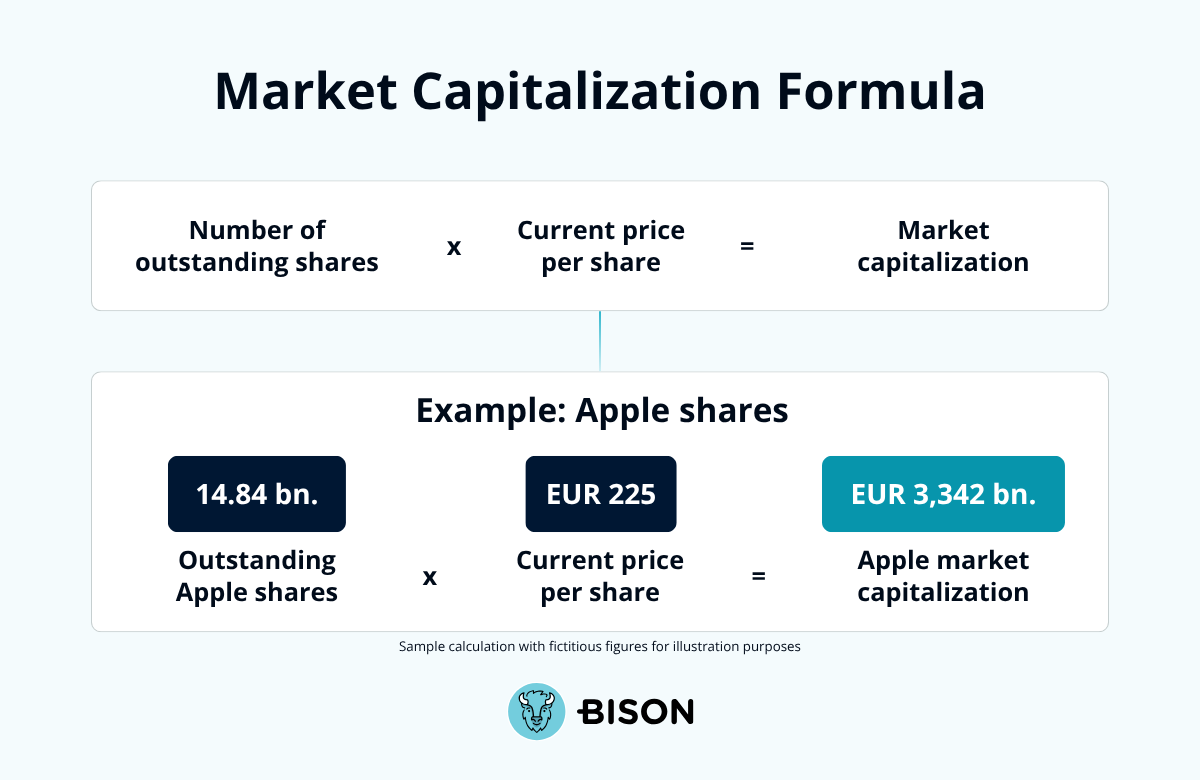
Only outstanding shares are included when calculating market capitalization. Outstanding shares are all shares held by shareholders. Shares held by the company itself are not included. The number of outstanding shares can be found, for example, in the company’s annual report.
Explanation: What is cryptocurrency market capitalization?
Market capitalization also plays an important role in the cryptocurrency market and is widely used as a key metric. It indicates how much money is currently invested in a cryptocurrency such as Bitcoin, and therefore reflects the total value of all coins currently in circulation. Like stocks, cryptocurrencies are also divided into different market capitalization categories:
| Category | Market Capitalization | Examples (as of 13.01.2026) |
|---|---|---|
| Large-Cap Cryptocurrencies | More than USD 10 billion | BTC (USD 1.85 trillion), BNB (USD 125 billion) |
| Mid-Cap Cryptocurrencies | Between USD 1 billion and USD 10 billion | UNI (USD 3.5 billion), PEPE (USD 2.5 billion) |
| Low-Cap Cryptocurrencies | Under USD 1 billion | FLOKI (USD 491 million), MANA (USD 280 million) |
However, these categories are not uniformly defined. As the crypto market continues to grow (with the total market capitalization of all cryptocurrencies currently standing at approximately USD 3.14 trillion), different thresholds may become relevant for evaluating cryptocurrencies in the future.
How is market capitalization calculated for cryptocurrencies?
To calculate the market capitalization of a cryptocurrency, the market price of a coin is multiplied by the number of coins currently in circulation.
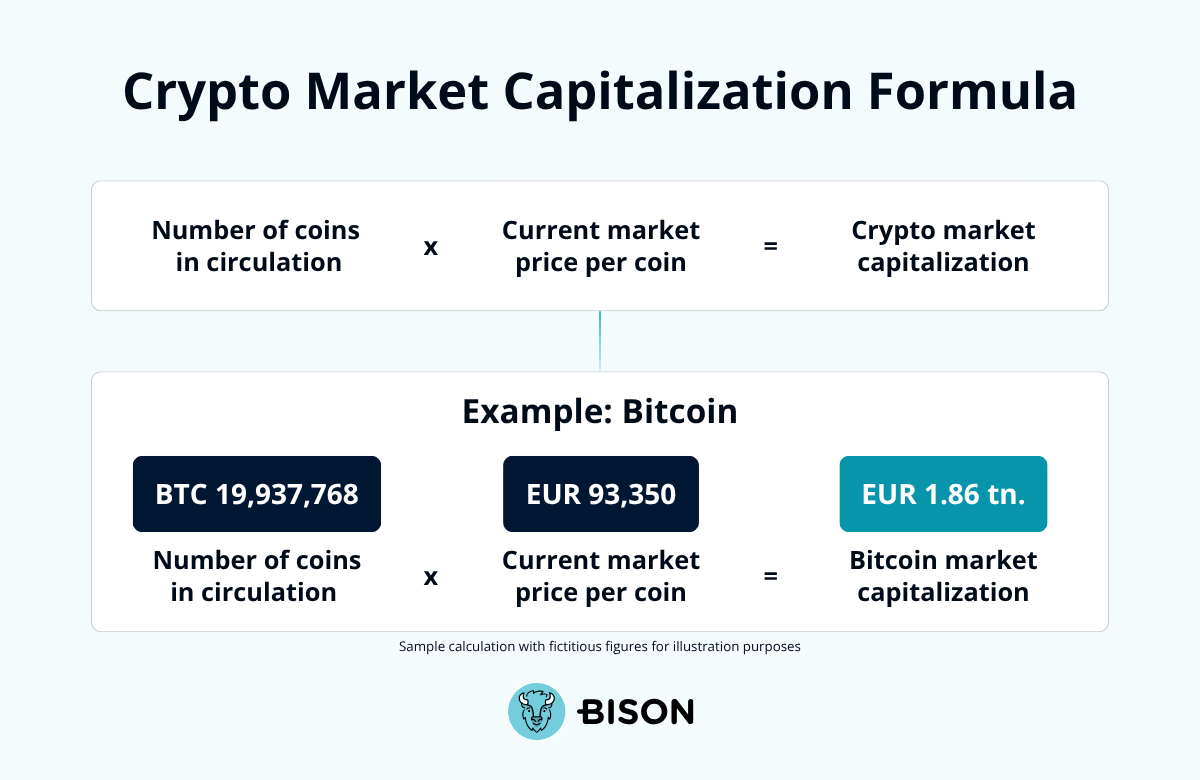
Another example for better understanding: Avalanche (AVAX) has 462,150,431.95 coins in circulation (as of 13.01.2026). AVAX currently has a value of USD 13.79. If you multiply the current market price per coin by the number of coins in circulation, you arrive at Avalanche’s market capitalization: approximately USD 5.93 billion.
In the BISON App, you can find an overview of the market capitalization of each cryptocurrency in the market data.
What does crypto market capitalization mean for investors?
The market capitalization of a cryptocurrency can help investors compare the acceptance and adoption of crypto projects or ecosystems independently of the price of an individual coin. Crypto market capitalization—which can fluctuate significantly due to the high volatility of the crypto market—can provide insights into market size, liquidity, and potential price fluctuations:
- Large-Cap Coins: Cryptocurrencies such as Bitcoin or Ethereum have a high market capitalization and are generally considered comparatively liquid, although they can still be subject to significant price fluctuations.
- Mid-Cap-Coins: These cryptocurrencies, such as Ondo or Aave, fall between large and small projects and may experience greater volatility and risk. In some cases, they may also offer higher growth potential.
- Low-Cap-Coins: Coins such as The Graph or Gala have a low market capitalization and are often less liquid, which can lead to very high price fluctuations and increased risk.
Which cryptocurrency has the largest market capitalization?
Bitcoin (BTC), the oldest cryptocurrency, is also the largest cryptocurrency by market capitalization, with a market cap of approximately USD 1.84 trillion (as of 13.01.2026). The entire crypto market has a total market capitalization of USD 3.14 trillion. The following table provides an overview of the ten largest cryptocurrencies by market capitalization:
| Rank | Cryptocurrency | Market Capitalization (rounded, as of 13.01.2026) |
|---|---|---|
| 1. | BITCOIN (BTC) | USD 1.84 trillion |
| 2. | ETHEREUM (ETC) | USD 377 billion |
| 3. | TETHER (USDT) | USD 186 billion |
| 4. | RIPPLE (XRP) | USD 125 billion |
| 5. | BINANCE COIN (BNB) | USD 125 billion |
| 6. | SOLANA (SOL) | USD 80 billion |
| 7. | USD COIN (USCD) | USD 74 billion |
| 8. | TRON (TRX) | USD 28 billion |
| 9. | DOGECOIN (DOGE) | USD 23 billion |
| 10. | CARDANO (ADA) | USD 14 billion |
Combined, the ten largest cryptocurrencies have a market capitalization of approximately USD 2.87 trillion, accounting for more than 90% of the total crypto market capitalization.