

Summary
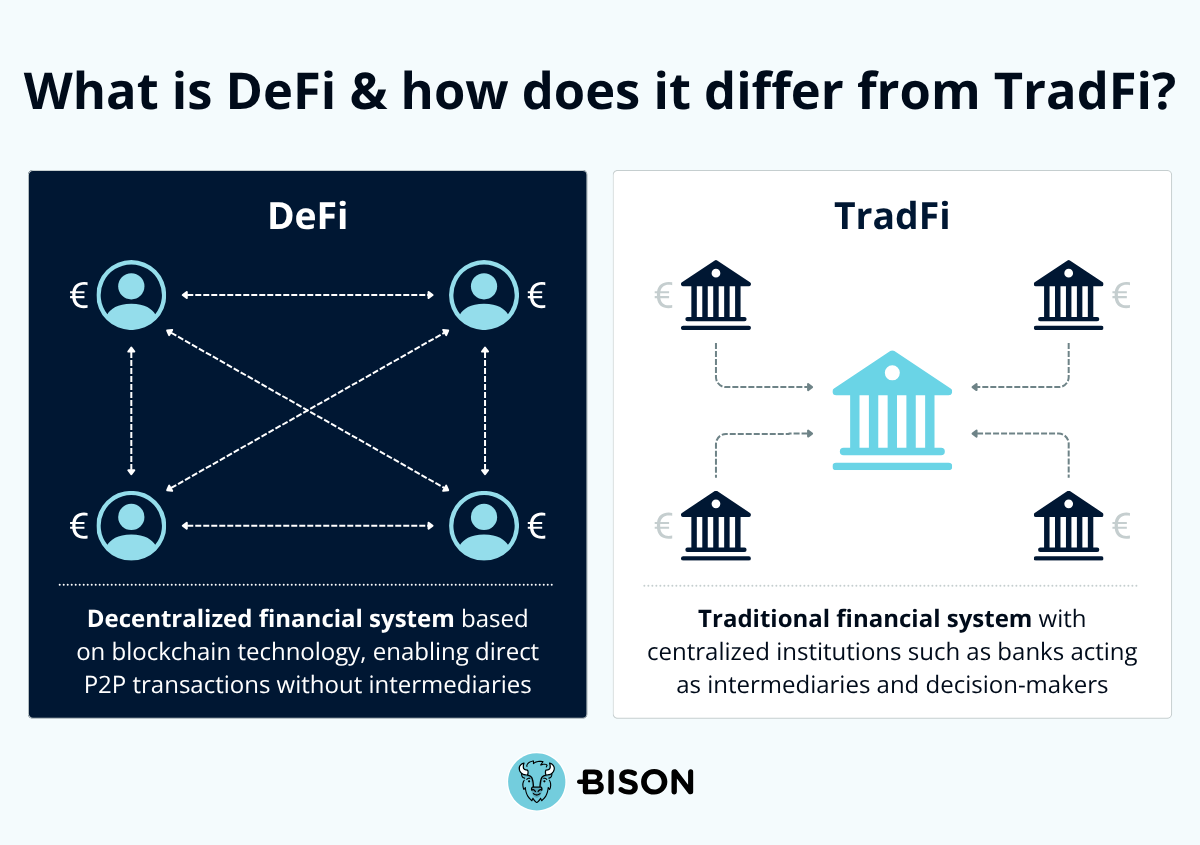
- DeFi stands for "Decentralized Finance" and describes a decentralized financial system based on blockchain technology that functions without banks or other intermediaries.
- Through dApps and Smart Contracts, you can directly utilize financial services such as trading, lending, or yield farming.
- DeFi provides global, transparent, and always-available access to financial applications.
- Despite all its advantages, DeFi is relatively complex compared to traditional financial services. Additional risks include technical errors, hacks, and – in projects associated with cryptocurrencies – high market volatility.
- The DeFi market is growing by 68% annually and is increasingly developing into an important component of the global financial system.
- With BISON, you invest simply, securely, and reliably in coins that are in direct connection with DeFi applications.
What is DeFi?
DeFi, short for “Decentralized Finance,” describes a new type of digital financial system that is entirely based on blockchain technology. In contrast to traditional finance (TradFi), where intermediaries such as banks and financial institutions act as gatekeepers and decision-makers, DeFi operates decentrally and enables peer-to-peer transactions (P2P) without intermediaries.
The DeFi market has been growing strongly for years. Between 2026 and 2033, experts are anticipating 68% annual growth, which corresponds to a market size of 1.4 trillion US dollars in 2033.
How Does DeFi Work?
DeFi operates through dApps (decentralized applications) that run on a corresponding blockchain – for example, on the Ethereum or Solana blockchain. Smart Contracts are executed there, which form the core of DeFi. These self-executing programs based on fixed parameters take on the role of classical financial intermediaries such as banks or exchanges: they execute transactions automatically and without human intervention as soon as predefined conditions are met.
dApps provide you with access to DeFi in a sense: they are the interface between users and the blockchain. Through these applications, you can interact directly with protocols without, for example, having to open an account with a bank. Instead, typically a crypto wallet is sufficient to initiate transactions, manage assets, or participate in DeFi applications.
For which Applications is DeFi Used?
DeFi is used for various financial services, particularly for lending and borrowing, classical trading (via DEX, that is, decentralized exchanges), yield farming, and for stablecoins.
Here is an overview of these and all other central DeFi applications:
These and all other central DeFi applications at a glance:
- Lending and Borrowing: With DeFi lending and borrowing, you can lend or borrow cryptocurrencies without banks. You can earn interest or take out loans by providing collateral.
- Yield Farming: In yield farming, you can earn rewards and fees by securing cryptocurrencies in a DeFi protocol.
- Prediction Markets: There are also DeFi applications that allow you to bet on the outcome of events such as elections or sporting events.
- Trading via Decentralized Exchanges (DEX): Cryptocurrencies can be traded directly between users – without a central platform.
- Stablecoins: Price-stable cryptocurrencies play a central role in the DeFi ecosystem, for example as a medium of exchange or collateral. In the BISON App, for example, you can trade the EURCV stablecoin.
What opportunities and risks does DeFi offer?
In 2023, Hamburg Commercial Bank determined in a study that DeFi has the potential to fundamentally redefine the role of financial institutions. Market growth and the advantages of maximum transparency to low costs underscore this assessment. At the same time, DeFi is also risky because the functionality around smart contracts and dApps is more complex for “standard bank customers” than traditional financial services.
What are the advantages of DeFi?
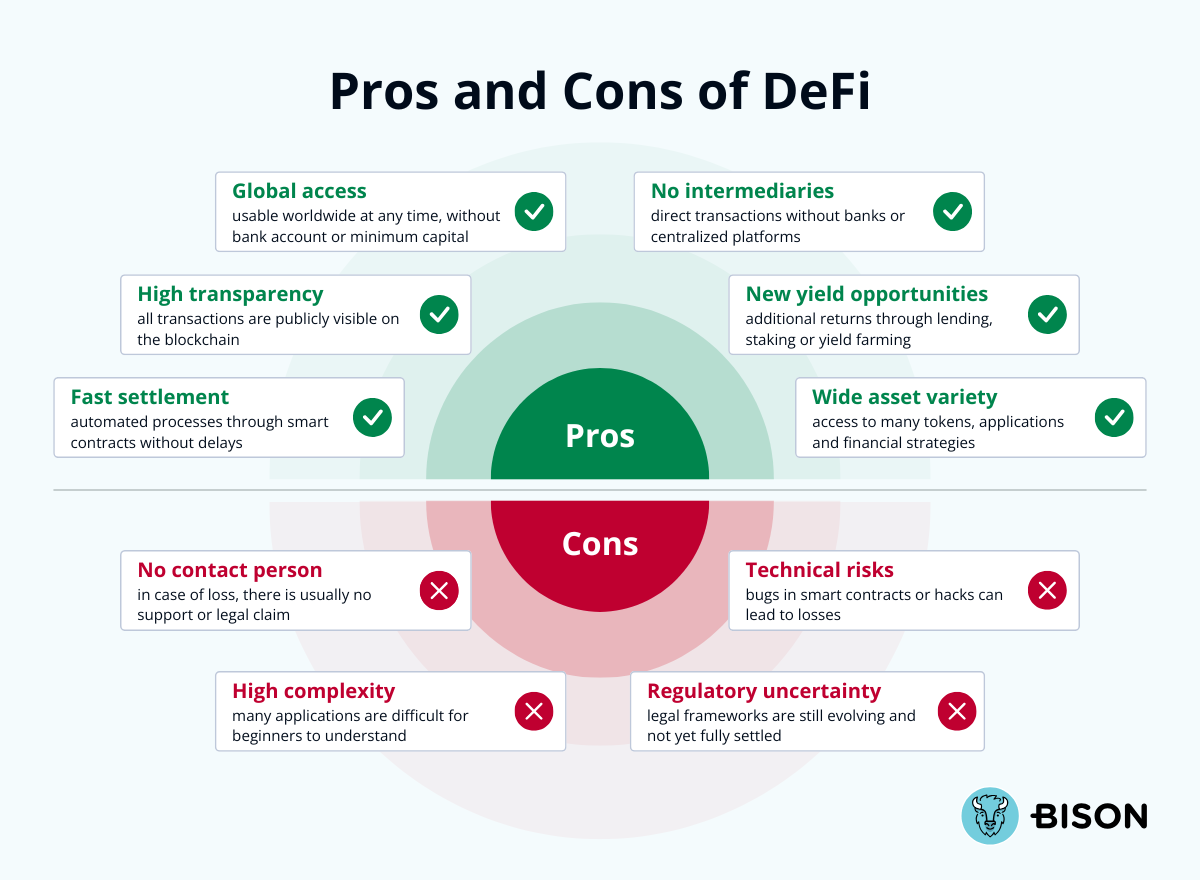
The greatest advantage of DeFi lies in access to financial services that is open and transparent to all people worldwide – often faster, more flexible, safer, and more independent than in the traditional financial system.
- Access to Financial Services: Unlike traditional finance, which often requires a certain amount of wealth or access to specific financial institutions, DeFi enables access to investments from anywhere in the world – at any time of day or night. You only need an internet connection.
- Variety of Digital Assets: With DeFi, you can invest in a variety of digital assets, including cryptocurrencies, without having to go through a bank or other financial institution. This also opens up more opportunities for people without bank accounts.
- Transparency: Through the elimination of intermediaries and the use of blockchain technology, all transactions are traceable. In the DeFi ecosystem, various applications interact with each other. For example, you can deposit money into a DeFi lending protocol and receive interest. These deposited funds can then be reused as collateral. All of these processes are transparently recorded on the blockchain.
- Security: DeFi applications are based on decentralized networks where transactions cannot be altered retroactively. This makes it more difficult for malicious actors to hack or exploit the system.
What are the disadvantages of DeFi?
Due to complete decentralization, there is no one to turn to in DeFi applications if something goes wrong – for example, in case of smart contract exploits or simply hacks. The complexity of DeFi also means that understanding the technology and participating in it is more demanding than with TradFi. Furthermore, DeFi projects (like the entire cryptocurrency market and related products) also carry an elevated level of volatility.While TradFi is heavily regulated, the legal framework for DeFi is still developing and differs significantly by region. In the EU, the MiCAR regulation is intended to provide clarity.
FAQ: Frequently Asked Questions about DeFi
What does DeFi stand for?
What is the difference between DeFi, CeFi, and TradFi?
Is DeFi the future?
How can I use DeFi?
To use DeFi, you typically need a crypto wallet and access to a dApp. Through this, you can, for example, trade, lend, or use other DeFi applications. If you are looking for an easier entry point, you can trade selected cryptocurrencies such as LINK, XLM, DOT, UNI, AAVE, and many others through the BISON App, which also play a role in the DeFi ecosystem.