

Summary
- Altcoins are all cryptocurrencies other than Bitcoin (BTC) and often offer additional features such as smart contracts or faster transactions.
- Ethereum (ETH) is the leading altcoin and serves as a platform for decentralized applications (dApps) and smart contracts. Many new crypto projects are based on Ethereum.
- There are different types of altcoins, including platform altcoins, payment altcoins, stablecoins, privacy coins, and interoperability altcoins.
- Altcoins vs. stablecoins: While altcoins are often more volatile, stablecoins (e.g., USDT, USDC) are typically pegged to fiat currencies and aim to maintain a stable value.
- When investing in altcoins, it is important to consider security, market analysis, and a long-term strategy, as they offer high return potential but also come with higher risks.
What are altcoins
Bitcoin (BTC) was the first cryptocurrency and still has the largest market capitalization. All cryptocurrencies created after Bitcoin are referred to as “altcoins” (alternative coins). Like Bitcoin, altcoins are based on blockchain technology, but they differ in their functionality and use cases. While some are designed primarily as a means of payment, others support decentralized applications (dApps), smart contracts, or fast and low-cost transactions.
Ethereum (ETH) – the most important altcoin
The best-known alternative crypto project is Ethereum (ETH). In addition to its own cryptocurrency, Ethereum also provides a programmable blockchain that allows developers to create decentralized apps (dApps) and smart contracts.
Many new crypto projects are built on Ethereum, which is why it plays a central role in the crypto ecosystem alongside Bitcoin. According to the crypto app tracker “State of the Dapps,” there are now around 3,000 tokens running on the Ethereum blockchain.
Types of altcoins and their use cases
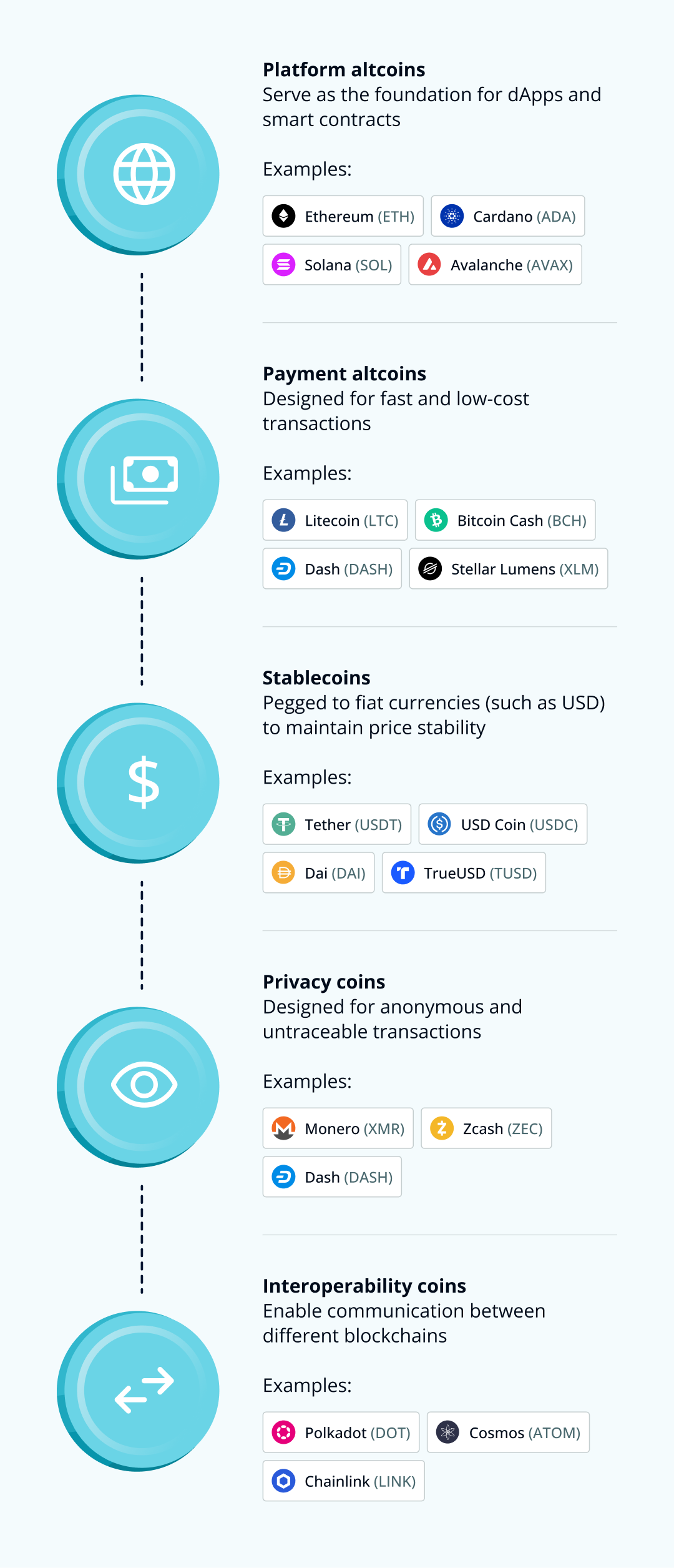
Not all altcoins serve the same purpose — they can be grouped into different categories:
- Platform altcoins: Provide the foundation for decentralized applications (dApps) and smart contracts. Examples: Ethereum (ETH), Cardano (ADA), Solana (SOL), Avalanche (AVAX)
- Payment altcoins: Designed for fast and low-cost transactions. Examples: Litecoin (LTC), Bitcoin Cash (BCH), Dash (DASH), Stellar (XLM)
- Stablecoins: Pegged to fiat currencies such as the US dollar to maintain price stability. Examples: Tether (USDT), USD Coin (USDC), DAI, TrueUSD (TUSD)
- Privacy coins: Focus on anonymous and untraceable transactions. Examples: Monero (XMR), Zcash (ZEC), Dash (DASH)
- Interoperability altcoins: Enable communication between different blockchains. Examples: Polkadot (DOT), Cosmos (ATOM), Chainlink (LINK).
Altcoins are constantly evolving, with new concepts and technologies regularly entering the market.
| Feature | Altcoins | Stablecoins |
|---|---|---|
| Definition | Cryptocurrencies other than Bitcoin | Cryptocurrencies designed to maintain a stable value |
| Value development | High volatility; prices can fluctuate significantly | Relatively stable prices, usually pegged to fiat currencies |
| Example | Ethereum (ETH), Cardano (ADA), Solana (SOL) | Tether (USDT), USD COIN (USDC), DAI |
| Use case | Smart contracts, dApps, DeFi, payments | Store of value, trading and transfers without converting to fiat |
| Goal | Further development of blockchain technology | Provide stability in the crypto market |
While altcoins are often more innovative and come with higher risks, stablecoins offer greater stability for users who want to preserve value in the short term or make transactions without converting to fiat currency.
Top 10 altcoins by market capitalization
Here are some of the most important altcoins that stand out in terms of market capitalization and use cases::
- Ethereum (ETH) – Platform for smart contracts and dApps
- BNB (BNB) – Native token of the Binance exchange
- Cardano (ADA) – Scalable blockchain for decentralized applications
- Solana (SOL) – High-performance blockchain with low fees
- XRP (XRP) – Payment network for banks
- Polkadot (DOT) – Connects different blockchains
- Avalanche (AVAX) – High-speed blockchain for DeFi projects
- Litecoin (LTC) – Fast and low-cost alternative to Bitcoin
- Dogecoin (DOGE) – Meme coin with strong community support
- Chainlink (LINK) – Decentralized oracle network for smart contracts
The list of altcoins continues to grow as new projects introduce innovative technologies and applications.