

Quick summary
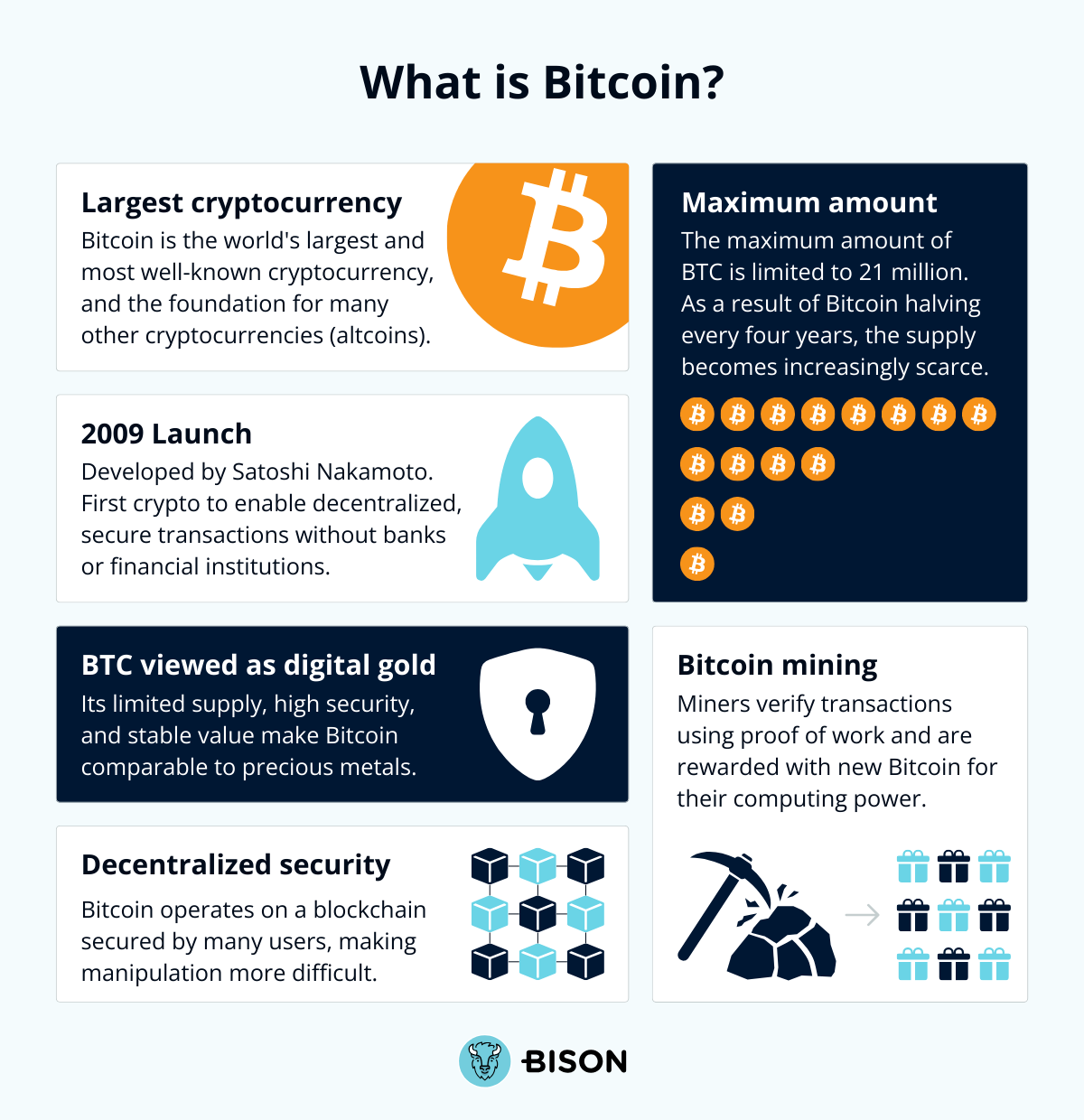
- Bitcoin (BTC) is the first cryptocurrency. Developed in 2009 by Satoshi Nakamoto, it enables decentralized and secure transactions without banks or other financial institutions. Bitcoin is mainly used for payments and as a store of value (“digital gold”).
- Bitcoin transactions are processed via the blockchain. Miners validate these transactions using the Proof-of-Work mechanism and receive new BTC as a reward.
- The network is secured by many independent users, making manipulation difficult and the blockchain particularly tamper-resistant.
- The maximum amount of BTC is 21 million. Through Bitcoin halving, which occurs approximately every four years, the creation of new coins is reduced, tightening supply.
- Altcoins are all cryptocurrencies other than Bitcoin. They have different use cases, such as smart contracts (Ethereum) or fast transactions (Litecoin), and often use different technologies.
Definition: What is the cryptocurrency Bitcoin (BTC)?
Bitcoin (BTC) is the first and best-known cryptocurrency. It was invented in 2009 by the pseudonymous Satoshi Nakamoto. Bitcoin is a decentralized, censorship-resistant, and technically secure digital currency that can be transferred directly between individuals via the blockchain network. It is used primarily as a store of value and also for payments.
The foundation of Bitcoin is the blockchain. It can be thought of as a continuous chain of data blocks in which all Bitcoin transactions are recorded. Every participant in the network has the same copy of the data. This allows manipulation to be quickly detected and prevented.
Bitcoin mining: How is Bitcoin created?
Bitcoin is created through a process known as “mining.” During mining, miners verify new transactions in the Bitcoin network. These transactions are combined into a new data block and appended to the blockchain. To do this, miners use computing power, which helps secure the network. In return, they receive newly created Bitcoin as a reward. Mining requires enormous computing power and involves costs. As an incentive, miners receive a block reward in the form of newly created Bitcoin. This results in two things happening at the same time:
- New Bitcoin enters circulation
- The network remains secure because miners continuously verify and append blocks
In this way, the mining process both creates new Bitcoin and helps maintain the integrity of the entire blockchain.
At the core of Bitcoin’s security and mining process is the Proof of Work (PoW) consensus mechanism. A consensus mechanism is a process through which all participants in a network agree on which data is valid. In the case of Bitcoin, miners carry out the following tasks:
- Verifying the transactions in a new block
- Solving a complex mathematical puzzle (hashing)
- Submitting the solution to the network
- Appending the confirmed block to the existing blockchain
Once a block is confirmed, the process starts again with the next block.
Is Bitcoin decentralized?
Bitcoin is decentralized, meaning that traditional centralized financial players such as banks or other financial institutions are not required. Instead, the blockchain network is maintained by many independent users who contribute computing power. They verify Bitcoin transactions and ensure that new Bitcoin enters circulation.
What makes Bitcoin valuable?
Bitcoin is often referred to as “digital gold” because, like the precious metal, it exists in limited supply and is therefore considered particularly valuable. The amount of Bitcoin that will ever exist is capped at 21 million units once this limit is reached, no new Bitcoin will be created.
Although a large share of Bitcoin is already in circulation, forecasts suggest that the last Bitcoin will not be created until the year 2140. The reason for this is the “Bitcoin halving” mechanism, under which the creation of new Bitcoin is reduced by half at regular intervals.
About every four years, a Bitcoin halving takes place, reducing the rewards paid to Bitcoin miners by half. This reduction in supply can potentially increase Bitcoin’s value, as the asset may become more attractive to investors. At the same time, however, a halving can also affect the profitability of mining and the overall security of the network.
What is the difference between Bitcoin and altcoins?
Bitcoin and altcoins are both cryptocurrencies, but they differ in their origin, purpose, and underlying technology. The term “altcoin” short for “alternative to Bitcoin refers to all cryptocurrencies that were developed after Bitcoin. As of January 2026, there are approximately 8946 altcoins, although this number fluctuates. Well-known examples include Ethereum, XRP, Litecoin, Dogecoin, and Solana. The highest number of altcoins was recorded in the summer of 2022 and again in early 2025, with just under 10,900 in each case. Altcoins can be grouped into various categories, including Layer-1 and Layer-2 blockchains, DeFi projects, Web3 infrastructure, stablecoins, exchange tokens, meme coins, as well as gaming and metaverse tokens.
| Feature | Bitcoin | Altcoins |
|---|---|---|
| Origin | First cryptocurrency (2009), origin of the entire crypto ecosystem | All coins that emerged after Bitcoin (over 9,000) |
| Quantity | 1 | 8946 |
| Market Capitalization | 1,7 trill. € | 1,15 trill. € |
| Purpose | Decentralized peer-to-peer money, digital store of value | Various (e.g., payments, smart contracts, DeFi, gaming, identity, privacy) |
| Technology | Native blockchain | Different blockchains |
| Consensus Mechanism | Proof of Work (PoW) | Various, e.g., Proof of Stake, Delegated Proof of Stake, ZK-Rollups |
| Functionality | Focus on security and decentralization, deliberately kept simple | Often extended functions such as smart contracts, programmable applications, staking |
| Supply Structure | Fixed maximum of 21 million BTC | Various: fixed, inflationary, or elastic models |
| Well-known Examples | - | Ethereum, XRP, Litecoin, Dogecoin, Solana |
Where can one buy Bitcoin?
You can buy Bitcoin via crypto exchanges, brokers, neobanks, peer-to-peer platforms and decentralized exchanges (DEX). The easiest and fastest way to buy Bitcoin is with BISON: in just a few clicks, you can create an account, deposit euros, and buy Bitcoin. BISON also provides reliable custody of your coins.