

Summary
- An Initial Coin Offering, or ICO, is a method for companies to raise capital by selling digital tokens to the public.
- In exchange, they receive fiat currency or cryptocurrencies like Bitcoin or Ethereum.
- The aim is to use these funds to finance their own crypto projects. • ICOs are also referred to as Initial Token Offerings, token sales, or token launches.
- In an ICO, investors can buy a new cryptocurrency directly from the developers at an early stage, before market launch and potential price increases.
- However, because ICOs are less strictly regulated, participating in them also involves a higher risk of significant losses for retail investors.
Definition: What is an Initial Coin Offering (ICO)?
Definition: What is an IAn Initial Coin Offering (ICO) is a way for companies to raise capital by selling tokens to the public. In return, the issuing companies—often young startups—receive funding for their blockchain or crypto projects. Depending on the ICO, this funding may be collected in fiat currencies such as US dollars and euros, or in established cryptocurrencies such as Bitcoin or Ethereum.
As a buyer, you invest in new tokens, projects, and ecosystems at a very early stage through an ICO. By doing so, you support crypto projects—often with the goal of increasing the value of your investment more quickly than with established coins. However, there is no guarantee of this.nitial Coin Offering (ICO)?
What are crypto projects? Crypto projects are initiatives based on blockchain technology. Their goals can vary widely, from developing a new digital currency to building entire ecosystems with decentralized applications or services.
How can I participate in an Initial Coin Offering (ICO)?
To participate in a token sale, you usually need a cryptocurrency to make the purchase, as well as a compatible wallet to transfer your funds—unless payment is made in fiat currency. On the ICO’s website, you’ll find instructions on how to connect your wallet and participate in the token sale.
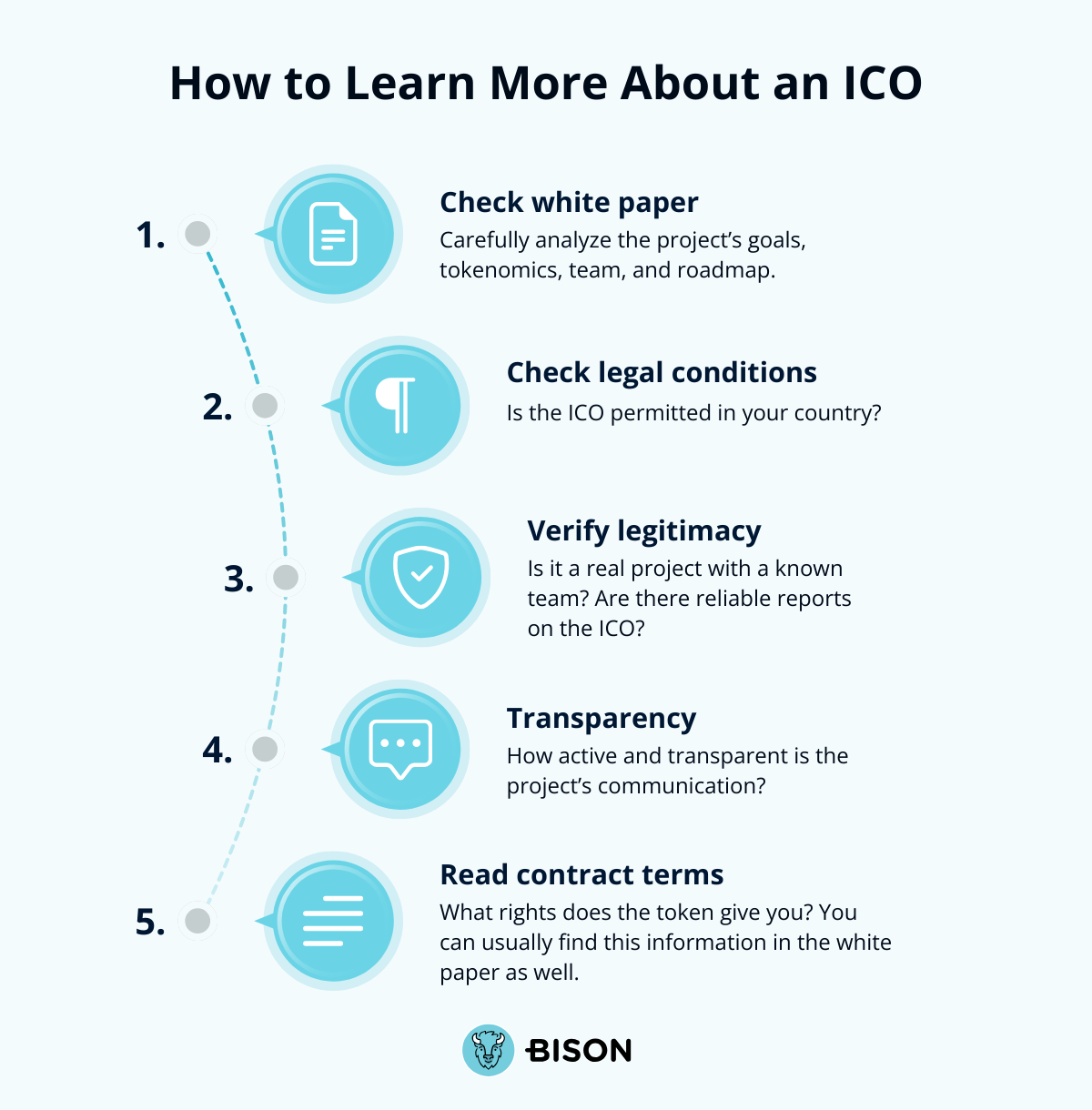
Important: Before participating in an Initial Coin Offering, you should research the ICO thoroughly:
- Check the whitepaper: Carefully review the project’s goals, tokenomics, team, and roadmap.
- Review legal frameworks: Is investing in the ICO permitted in your country?
- Verify the project’s legitimacy: Is it a real project with a known team? Are there reputable media reports about this ICO?
- Assess transparency: How active and open is the project team’s communication?
- Read the contract terms: What rights do you receive with the token? This information can usually also be found in the whitepaper.
Based on this research, you can assess the level of risk involved. As with any investment, a total loss of your investment is always possible with an ICO. Since ICOs are not regulated as strictly as their stock market counterpart (an IPO, or initial public offering), extra caution is needed.
You can find information about current and upcoming ICOs on platforms like Coinspeaker and CoinMarketCap.
How does an ICO differ from an Initial Public Offering (IPO)?
An Initial Coin Offering (ICO) is similar to the traditional process of going public—an Initial Public Offering (IPO). In an IPO, a company offers its shares to the public on the stock exchange. Unlike an IPO, an ICO is less strictly regulated, and the tokens purchased do not always represent a stake in the project or a share in its profits.
How does an Initial Coin Offering (ICO) work for issuing companies?
If you’re planning to develop a new crypto project, it’s important to research the process thoroughly in advance. There are various ICO providers that support young companies in conducting a token sale. This stage can already be relevant for potential buyers, as third parties analyze and evaluate projects, coins, and ecosystems. These evaluations can help you decide whether to participate in a token sale.
An ICO (or token sale) usually takes place in three steps, which we’ll explain using the example of Ethereum.
1. Project presentation
The startup or company defines its project and then presents the idea to the public. It outlines the planned project and its goals in a whitepaper. Investors also learn how the company plans to use the funds, the target funding amount, and the token issuance price.
Ethereum's whitepaper was published in November 2013, followed by the "Yellow Paper" in April 2014. The presale was announced in mid-2014. According to the developers, the goal of the ICO was to develop the protocol, conduct security audits, and fund the Ethereum Foundation. The initial price was about 2,000 ETH per BTC and was later reduced to about 1,337 ETH per BTC—equivalent to around 0.31 USD per token. Investors could only participate using BTC. The sale period lasted 42 days.
2. Creating a new token
The company selects the appropriate blockchain technology (for example, platforms like Ethereum, Waves, or Binance Smart Chain) and creates a token for the ICO.
Ethereum developed its own blockchain and used the ICO to issue its native currency, ETH, rather than an ERC-20 token. During the presale, buyers received an encrypted file containing their personal key (keyfile), which they could later use to access their tokens.
3. Token sale
The token sale takes place over a defined period, usually via a dedicated website. The ICO ends once the funding target has been reached.
Ethereum’s token sale ran from July 22 to September 2, 2014, raising around 31,500 BTC—equivalent to approximately 19 million USD. After the ICO was successfully completed, buyers were able to access their ETH following the launch of the network via official clients such as Mist or Geth.
6 well-known examples of successful ICOs
The following ICOs were successful, and their coins and associated projects are still in use today:
| Project | Year(s) | Volume (approx.) | ICO price (per token, approx.) | Current Price (as of Oct 13, 2025) |
|---|---|---|---|---|
| Ethereum (ETH) | 2014 | 19 million USD | 0,31 USD | 4.155 USD |
| Filecoin (FIL) | 2017 | 257 million | 5 USD | 1,67 USD |
| EOS | 2017 bis 2018 | 4,2 billion USD | 0,27- 0,31 USD | 0,315 USD |
| Tezos (XTZ) | 2017 | 232 million USD | 0,47 USD | 0,6455 USD |
| Cardano (ADA) | 2015 - 2017 | 62 million USD | 0,0024 USD | 0,7189 USD |
| Binance Coin (BNB) | 2017 | 15 million USD | 0,10 USD | 1.324 USD |
One thing all tokens have in common is that you can trade them as a retail investor on platforms like BISON—provided the platform supports the respective token. While you can’t participate directly in an ICO via the BISON app, you can trade coins like ETH, XTZ, and more than 40 others.
What are the advantages and disadvantages of a token sale for investors?
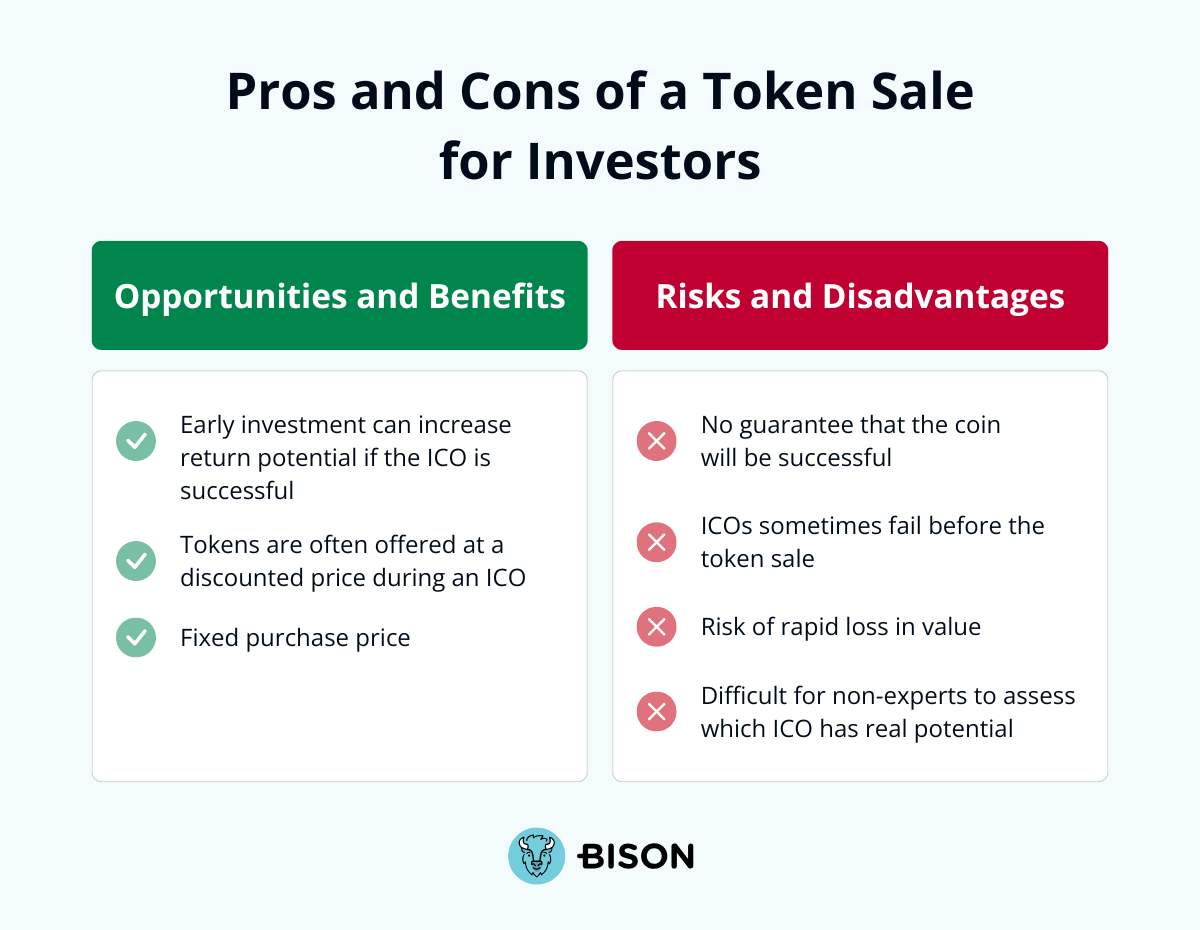
While ICOs allow companies and projects to raise capital quickly, they also offer investors several potential benefits:
- If an ICO is successful, early investors may benefit from higher return potential.
- Tokens are often offered at a reduced price during the ICO (e.g. in a presale).
- Tokens are purchased at a fixed price and are not yet affected by market fluctuations.
At the same time, there are also risks and disadvantages:
- There is no guarantee that the coin will succeed on the market.
- Some ICOs never reach the market, and projects may fail before launch.
- Tokens may lose significant value very quickly.
- It can be difficult—especially for beginners—to assess which ICOs have real potential.