

Summary
- With a crypto wallet, you can store, send, receive, and track cryptocurrencies like Bitcoin, Ethereum, or XRP.
- Wallets generate public and private keys, as well as a seed phrase, which can be used to recover the wallet in case of an emergency.
- There are hardware wallets (offline and very secure), software wallets (online and convenient), and paper wallets (offline, but risky).
- For beginners, software wallets or regulated providers like BISON, which offers custodial wallets and handles safekeeping for you, may be suitable.
- Important selection criteria for a crypto wallet include security, fees, and reliability.
What is a crypto wallet?
In most cases, a crypto wallet is software or hardware that enables cryptocurrency holders, such as Bitcoin or Ethereum users, to track, send, and receive their coins via the blockchain. You can think of a wallet as a digital keychain: just as you use a physical key to open a safe deposit box with fiat money, a crypto wallet contains the keys required to access your coins on the blockchain. The wallet does not store the cryptocurrencies themselves, but instead the access keys that allow you to manage them.
Are there differences between Bitcoin wallets, Ethereum wallets, and wallets for other cryptocurrencies?
Bitcoin, Ethereum, and many other cryptocurrencies use different technical standards, which means not every crypto wallet automatically supports every type of coin.
- Bitcoin wallets are based on the UTXO model and use their own address formats, such as bech32.
- Ethereum wallets operate on an account-based model and support various token standards, such as ERC-20, ERC-721 (NFT), and ERC-1155.
- Solana wallets operate on a completely different system (Proof –of History and Solana’s own program library), which requires dedicated wallets, such as Phantom or Solflare.
- Cardano wallets use a modified version of the UTXO model (EUTXO) and require compatible wallets, such as Lace or Eternl.
Many modern multi-chain wallets now support several networks simultaneously. It is important that your crypto wallet supports the respective blockchain and its token standard.
Are cryptocurrencies stored in a crypto wallet?
No, your crypto wallet does not store the cryptocurrencies themselves; they always remain on the blockchain. A wallet is not like a USB stick that stores cryptocurrency files. Instead, a wallet stores your private keys. These keys are comparable to extremely complex passwords that prove your ownership of a certain amount of cryptocurrency and allow you to transfer them.
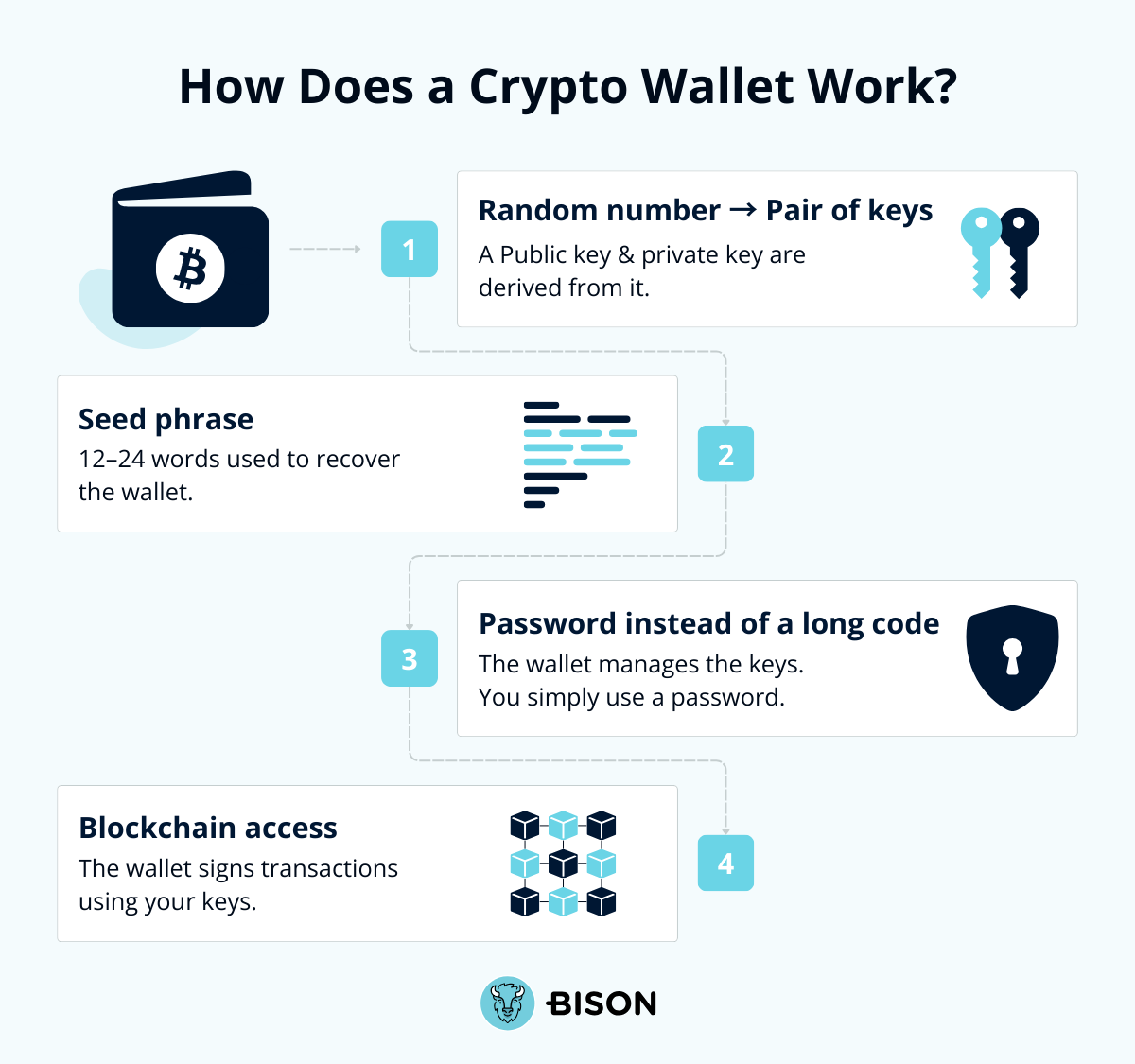
Thanks to crypto wallets, you don't need to memorize these complex private keys. Instead, you only need to remember a password you choose to access your wallet.
How does a crypto wallet work?
Creating a digital wallet involves generating a random number from which a key pair—known as a public and a private key—is derived. In addition, a seed phrase is generated—a combination of words that allows you to recover your wallet in an emergency.
Thanks to crypto wallets, you don't need to memorize these complex private keys. Instead, you only need to remember a password you choose to access your wallet.
Public and private Keys
Like a PIN for a bank account, a wallet requires authentication. A distinction is made between public keys and private keys:
| Public key | Private key | |
|---|---|---|
| Function | Uniquely identifies your wallet | Authorizes transactions (similar to a signature) |
| Comparison | Username | Password / secret access code |
| Visibility | Public and can be shared safely | Strictly secret, must never be shared |
| Role | Enables you to receive cryptocurrencies | Controls the wallet and allows you to send coins |
| Security | Cannot be used to access the wallet | Grants full control over the wallet |
| Impact if lost | No critical consequences; it can be shared again | Loss means losing access (recoverable only via the seed phrase) |
| Generation | Cryptographically derived from the private key | Randomly generated; forms the basis for the public key and seed phrase |
What types of crypto wallets are there?
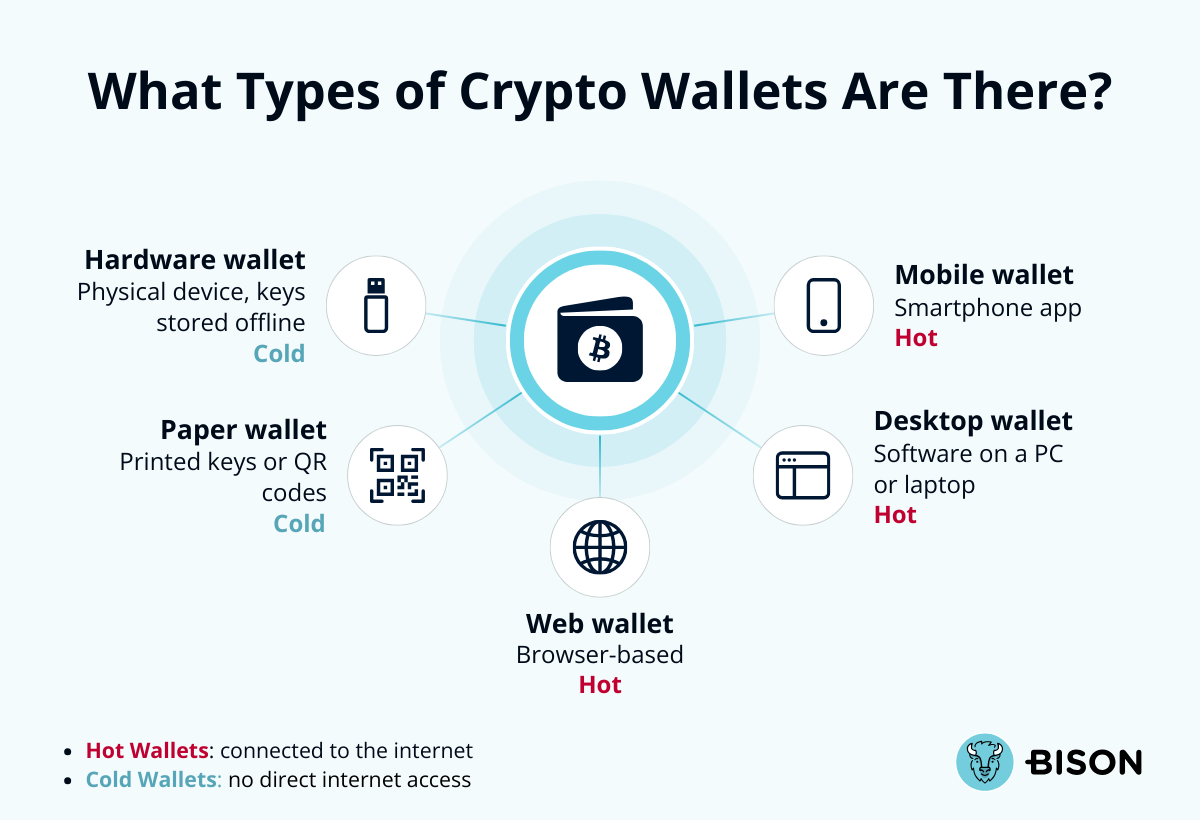
There are three main types of crypto wallets: hardware wallets, software wallets, and paper wallets. Software wallets are further divided into desktop, mobile, and web wallets.
| Wallet type | Type* | Short description | Adventages | Disadventages | Examples |
|---|---|---|---|---|---|
| Hardware wallet | Cold | Physical device with keys stored offline | Very secure; ideal for large amounts | Less convenient, costs money | Ledger, BitBox |
| Desktop wallet | Hot | Software installed on a PC or laptop | Good control; stored locally on your device | Only as secure as your device | Electrum, Wasabi |
| Mobile wallet | Hot | Smartphone app | Very convenient, ideal on the go | Higher online security risk | BlueWallet, Trust Wallet |
| Web wallet | Hot | Browser-based wallet | Easy and accessible anywhere | Highest security risk (server-based) | Highest security risk (server-based) |
| Paper wallet | Cold | Printed keys or QR codes | Completely offline | Easily lost or damaged | - |
*Hot wallets are continuously connected to the internet; cold wallets are offline.
Hardware wallets (cold wallets)
Hardware wallets are physical devices, similar to small USB sticks. They store your private keys offline and are therefore among the most secure types of crypto wallets. To make a transaction, you briefly connect the device to a computer. Afterward, your keys are stored offline again.
Typical features of hardware wallets:
- Offline storage of private keys
- Very strong protection against online hacking
- Ideal for larger amounts or long-term storage
- Examples: Ledger, BitBox
Software wallets (hot wallets)
Software wallets run on devices connected to the internet and are especially suitable if you make frequent transactions. This makes them much more convenient, but less secure than hardware wallets.
There are three types of software wallets:
- Desktop wallets: Programs installed on your PC or laptop. They run locally on your device and give you full control but are only as secure as your computer. Examples: Electrum, Wasabi.
- Mobile wallets: Apps installed on your smartphone—similar to Apple Wallet—that enable simple transactions via QR codes. Examples: BlueWallet, Trust Wallet.
- Web wallets: Web-based crypto wallets that can be accessed through a browser and allow transactions from anywhere. However, your login data is stored on online servers, which increases security risk. Example: MetaMask.
Typical features of software wallets:
- Very convenient and easy to access
- Various types available
- Ideal for beginners
- Higher security risk due to constant internet connection
Paper wallets (cold wallets)
A paper wallet is a document generated entirely offline. It’s usually a printed sheet that contains your public and private keys, often shown as QR codes. Although it offers maximum offline security, it can easily be lost or damaged.
Typical features of paper wallets:
- 100% offline
- Extremely secure against online attacks
- Vulnerable to fire, water, or loss
- Not recommended
The best crypto wallet is always the one that fits your needs. There is no universally "best" wallet—each type has its own strengths and weaknesses. For example, if you buy Bitcoin once and plan to hold it long term, a hardware wallet may be a good choice. If you trade regularly, software wallets are usually more convenient.
Which crypto wallet is the best?
The best crypto wallet is always the one that fits your needs. There is no universally “best” wallet—each type has its own strengths and weaknesses. For example, if you buy Bitcoin once and plan to hold it long term, a hardware wallet may be a good choice. If you trade regularly, software wallets are usually more convenient.
If you don’t want to deal with secure storage at the beginning, you can simply buy your cryptocurrencies directly on BISON. We take care of custody for you—fully regulated and without the need to set up your own wallet. This is known as a custodial wallet, where a third party manages the safekeeping for you.
How much does a crypto wallet cost?
The cost of a crypto wallet largely depends on the wallet type and services you use. It can range from free to around €300.
- Hardware wallets such as Ledger devices involve a one-time purchase cost of roughly €50 to €300. When sending cryptocurrencies, network fees apply for transactions on the respective blockchain.
- One exception is transferring cryptocurrencies from BISON to your own wallet—this is free of charge.
- Software and web wallets typically have no download or setup fees, but may charge fees for additional in-app services. There may also be extra costs for certain security features, such as backup solutions. Network fees also apply.
How to find the right crypto wallet for you
When choosing a crypto wallet, three factors are particularly important: customer service, fees, and security.
- Customer service: Especially if you’re a beginner, choose a crypto wallet with reliable support that is easy to reach. This can be helpful if you run into problems. 2
- Fees: Sending cryptocurrencies can incur costs, and wallet apps may charge additional fees.
- Security: Choose a provider that is secure and reliable. For example, BISON is licensed, based in Germany, and can be reached via their support team.